
Summary
Editor's rating
Value: who should actually spend money on this
Design: compact, heavy, and clearly built around the plate
Materials and build: more solid than fancy
Durability and day-to-day use
Performance: how well it actually freezes and rolls
What you actually get out of the box
Effectiveness: does it really deliver "rolled" ice cream at home?
Pros
- Built-in compressor freezes the plate quickly and allows multiple batches in a row
- Stainless steel plate and spatulas feel sturdy and handle scraping and rolling well
- Compact footprint and suction feet make it stable and practical for small kitchens
Cons
- Small 0.5-quart capacity per batch, not ideal for serving larger groups
- Heavy unit that’s not convenient to move in and out of storage frequently
- Requires chilled base and some technique; not as effortless as a standard churn machine

Specifications
View full product page →| Brand | Whynter |
A rolled ice cream toy that’s actually a real machine
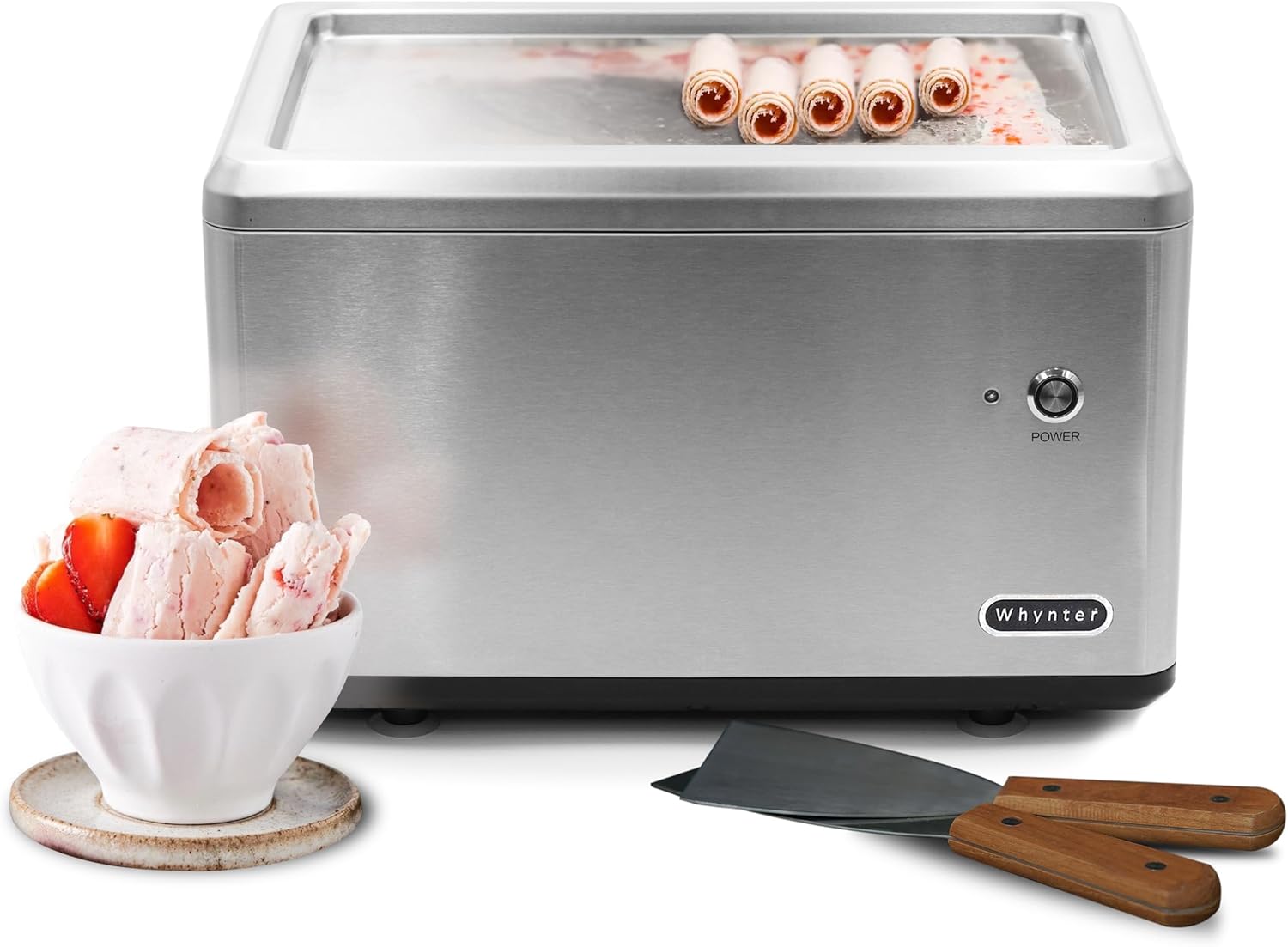
I’ve been curious about these rolled ice cream makers for a while, but most of the cheap ones are basically metal plates you throw in the freezer and hope for the best. The Whynter ICR-300SS is different: it has a built-in compressor, so it’s a real freezing unit, not a gimmick tray. I used it over a couple of weekends, mainly for family desserts and to see if it could handle a small "ice cream night" with several batches in a row.
Right away, the thing that stood out is that it actually gets cold fast. We’re talking down around the stated 10°F range on the plate, and you can see the mix starting to set within a couple of minutes if your base is properly chilled. It’s not instant magic, but it’s quick enough that people don’t get bored waiting around. Compared to the freezer-bowl machines I’ve used, not having to pre-freeze anything is a big relief.
At the same time, it’s not perfect. The capacity is only 0.5 quarts per batch, and rolled ice cream takes more hands-on work than a normal churn machine. You’re scraping, spreading, and rolling on the plate, so it’s more like cooking at a teppanyaki grill than pushing a button and walking away. If you want to serve more than 3–4 people, you’re going to be standing there for a while.
Overall, my first impression is: it’s a pretty solid little machine if you actually like the rolled ice cream style and enjoy the process. If you just want a big tub of ice cream with minimal effort, there are better options. But for what it’s made to do—small batches of rolled ice cream on demand—it mostly gets the job done without too much hassle.
Value: who should actually spend money on this
On the value side, this is not the cheapest way to make frozen desserts at home, but it’s also not in the top luxury tier. You’re paying for the built-in compressor and the novelty of rolled ice cream. If you compare it to a basic freezer-bowl ice cream maker, those are cheaper but also more annoying: you have to remember to freeze the bowl overnight, you can usually only do one batch at a time, and the texture is often softer unless you freeze again after churning.
Compared to a full-size 2-quart compressor ice cream maker, this Whynter rolled model is smaller and usually a bit cheaper, but also much more limited in capacity. With a traditional compressor machine, you can make enough ice cream for a family in one go and just walk away while it churns. With this plate, you’re making smaller, more interactive portions. So the value depends on whether you want that interactive, "show" style or just volume. For pure practicality, I’d pick a regular compressor machine. For fun evenings and custom creations, this one makes sense.
Considering the 4.5/5 rating and how it actually performed for me, I’d say the price is fair but not a bargain. You’re getting a sturdy piece of equipment that does what it says, without a ton of extra features. If you only make ice cream a couple of times a year, it’s probably overkill. If you enjoy experimenting with flavors, hosting small groups, or have kids who like the rolled ice cream shop experience, you’ll probably get your money’s worth over time.
So in terms of value: decent, with a clear target user. It’s not the all-purpose ice cream solution for everyone, but for someone who specifically wants rolled ice cream at home and doesn’t mind the hands-on work, the cost lines up reasonably with what it delivers.
Design: compact, heavy, and clearly built around the plate
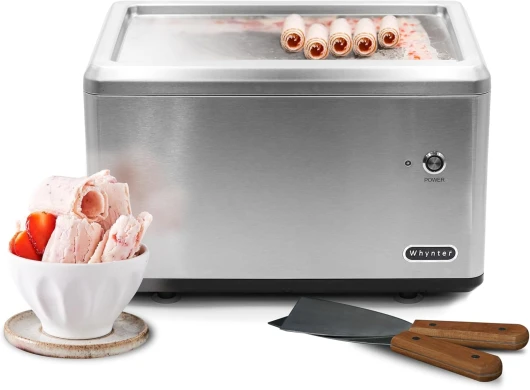
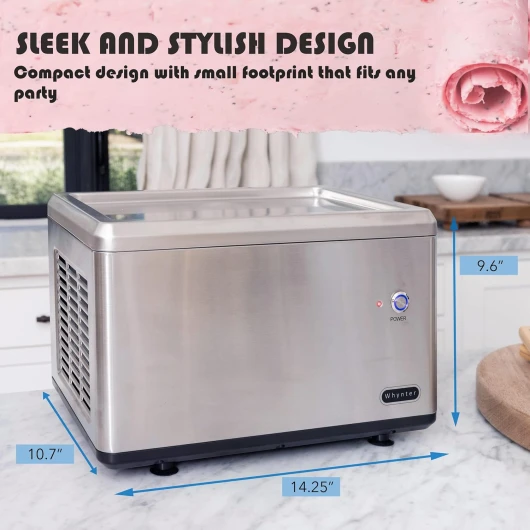
The design is pretty simple: stainless steel body, flat freezing plate on top, and basic controls on the front. The first thing you notice when you lift it is the weight. At around 24 pounds, it’s dense for its size. That’s mostly the compressor and the cooling system. It’s not something you casually move in and out of a cabinet every time you want dessert. After the first weekend, I just left it on a side counter because dragging it around got old fast.
The top plate is the main feature. It’s a smooth stainless surface surrounded by a slight lip. That lip matters, because if you pour too much base, you’ll quickly find the liquid creeping toward the edge. I learned to keep the base volume modest per batch, especially if I wanted to mix in fruit chunks or cookies. If you fill it too close to the limit, it can spill over while you’re scraping and spreading. So you have to respect that 0.5-quart capacity and, in reality, often stay a bit under it.
On the bottom, the four suction legs are more useful than I expected. When you’re pushing and scraping with some force, a normal appliance would slide around. Here, once the legs are stuck to a clean counter, the unit stays put. That’s important because you’re doing more mechanical work than with a standard ice cream maker. The whole design feels centered around the idea that you’ll be scraping aggressively on the plate.
Control-wise, there’s nothing complicated. You’ve got simple buttons and clear icons. No app, no Bluetooth, nothing "smart", which I actually liked. The design is more "sturdy tool" than "trendy gadget". It’s not pretty or decorative, but it looks like it belongs next to other stainless kitchen appliances. If you care about aesthetics a lot, it’s just okay—decent looking, slightly boxy, and very obviously a machine made to do one job.
Materials and build: more solid than fancy
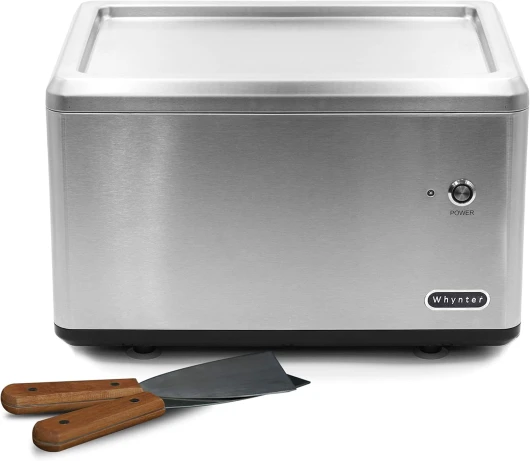
Most of what you touch on the ICR-300SS is metal, mainly stainless steel, which is what I prefer for anything that deals with cold food and scraping tools. The freezing plate feels thick and rigid, not like a thin sheet that’s going to warp. When you’re pushing the spatulas across it, there’s no flex or weird sound, just a normal metal-on-metal scrape. The body panels are also stainless, with some plastic on the trim and control area, which is standard for this kind of appliance.
The spatulas are also stainless steel with simple handles. They feel like they’ll last, and they’re the right stiffness: they bend just enough when you’re rolling but don’t feel flimsy. The edges are straight and even, which matters a lot if you want clean rolls instead of messy curls. I would have liked a third spatula in the box, just as a backup or for a second person helping, but what’s included is usable. If you plan to do this often, I’d honestly grab an extra pair of similar spatulas online.
The suction feet are rubbery and grip well. No complaints there. The plastic used on the control panel and some trim doesn’t feel premium, but it doesn’t feel cheap either. It’s the typical mid-range appliance plastic: fine as long as you don’t abuse it. There are no obvious weak hinges or fragile clips because there aren’t many moving parts externally. That’s one upside of this design: less to break.
From a materials point of view, it feels like a practical kitchen tool, not a luxury item. It’s not trying to impress you with shiny chrome details or fancy knobs. Everything that needs to be tough (plate, spatulas, housing) is metal; the rest is functional plastic and rubber. For the price range, I’d say the materials are fair. There are nicer-looking machines out there, but for rolled ice cream, I’d rather have a thick, cold plate and solid spatulas than a pretty housing.
Durability and day-to-day use
I obviously haven’t had this thing for years, but based on a few weeks of use and the way it’s built, I can give a reasonable idea of durability. The compressor-based design is similar to other Whynter ice cream machines and small freezers, and those tend to hold up if you don’t abuse them. The heavy weight and solid body panels give the impression that the internal components aren’t rattling around loosely. I didn’t notice any weird vibrations or rattles, even when it had been running for a while.
The top plate is the main wear point, since you’re constantly scraping metal spatulas across it. After several sessions, I didn’t see any deep scratches or damage, just normal fine marks you’d expect from metal-on-metal contact. As long as you don’t go at it with knives or super hard tools, I don’t see it failing quickly. The spatulas themselves also held up fine—no bending, no warping in hot water during cleaning.
The suction feet stuck well at the beginning but do need a clean, smooth counter. If there’s flour, sugar, or crumbs under them, they lose grip and the unit can slide a bit when you push hard. That’s more user behavior than a durability issue, but something to keep in mind. The controls and buttons didn’t feel loose or wobbly. They click reliably, and there’s no sense that they’ll fall into the housing anytime soon.
In terms of long-term concerns, I’d say the main risk is like any compressor appliance: if the cooling system fails, the whole thing is basically done. You can’t really DIY fix a sealed system easily. But that’s true for all compressor ice cream makers and mini freezers. Based on the build and all the user feedback I saw, I’d rate durability as pretty solid for home use, as long as you’re not dragging it around constantly or letting kids slam the spatulas into the plate like hammers.
Performance: how well it actually freezes and rolls
Performance-wise, this is where the Whynter ICR-300SS does its job fairly well, as long as you respect a few rules. The key one: chill your base properly first. When I used a base that had been in the fridge for a few hours, I could see it starting to freeze on the plate in about 1–2 minutes. From pouring to scraping proper rolls, you’re looking at roughly 5–8 minutes per batch depending on how thick you spread it and how cold your mix was. If you pour room-temperature mix, it still works, but you’re going to be there longer, and the machine has to work harder.
Once the plate is cold and your base is right, it does freeze evenly enough to make clean rolls. You spread the mix thin with the spatulas, wait until it goes matte and firm, then scrape at a shallow angle to roll it up. When I rushed it, I got broken, half-formed rolls. When I waited another minute or two, the rolls came out much nicer. So there’s a small learning curve, but nothing crazy. For kids watching, it’s pretty fun, but they’ll need an adult doing the actual scraping at first.
The built-in compressor is the real advantage. You can do multiple batches in a row without having to refreeze anything, which is a big step up from the freezer-bowl style makers. I did three small rounds back-to-back for different flavors. The plate stayed cold enough the whole time, though I noticed it took slightly longer to freeze by the third round. Noise-wise, it hums like a small fridge or air conditioner—present but not obnoxious. You can still talk over it without shouting.
One limitation: the 0.5-quart capacity means you’re not cranking out large quantities fast. It’s fine for 2–3 people per round, maybe 4 if you’re doing smaller portions. If you’re thinking of doing a big party, just know you’ll be tied to the machine for a while. Overall, in terms of performance, I’d call it reliable and consistent once you figure out your base and portion size, but not some magical mass-production unit.
What you actually get out of the box
Out of the box, the Whynter ICR-300SS is pretty straightforward. You get the main unit, two stainless steel spatulas, a power cord, and the basic paperwork. No fancy accessories, no huge recipe book, just enough to get going. The machine itself is smaller than a standard compressor ice cream maker, but still not tiny. It’s about 10.7 x 14.25 x 9.6 inches and a bit over 24 pounds, so it’s more of a "find it a spot on the counter" appliance than something you casually pull out every day.
The two spatulas are sized right for the rolling process. They’re not flimsy, and the metal edge is sharp enough to scrape frozen mix cleanly off the plate without feeling like you’re gouging it. You don’t get extra bowls or paddles because this thing doesn’t churn in a bowl; the plate itself is the work area. That also means you don’t have a lot of parts to lose or break, which I liked. Setup is basically: unpack, wipe down, plug in, let it sit upright for a while (I gave it 24 hours just to be safe with the compressor), and you’re ready.
The manual is basic but clear. It explains the steps, gives some timing guidelines, and has a few starter recipes. Nothing fancy, but enough if you’ve never made ice cream before. If you’re used to those old salt-and-ice bucket machines, this will feel like a big upgrade in terms of mess and simplicity. No rock salt, no big dripping bucket, no bowl you have to freeze overnight and then somehow find space for in the freezer again.
In practice, the "presentation" of the product is basically: this is a compact, self-contained rolled ice cream station. No plastic gimmicks, no overcomplicated controls, just a metal box that gets cold and a couple of spatulas. If you’re expecting a whole kit with toppings containers, kid-friendly decorations, or a big recipe bible, you’ll be disappointed. If you just want a functional machine and you’re fine looking up recipes online, it’s enough.
Effectiveness: does it really deliver "rolled" ice cream at home?
In practice, the big question is: does this thing actually give you the rolled ice cream you see in videos, or is it just messy frozen slush? After a few tries, I’d say it gets pretty close to the real deal if you’re willing to put in a bit of effort. When you pour a properly chilled base, spread it thin, and wait long enough, you can scrape up rolls that look decent and hold their shape in the bowl. They’re not Instagram-perfect every time, but they’re clearly rolls, not random chunks.
Texture-wise, the ice cream comes out denser than typical churned ice cream, which matches the description: less air whipped in, more intense taste. If you use a good base recipe with enough fat and sugar, you get a smooth, rich texture. When I tried a very light mix with just almond milk and fruit, the result was more icy, but still enjoyable. That’s more about the recipe than the machine. So the effectiveness depends heavily on your mix, but the plate itself does what it’s supposed to do: freeze fast and evenly enough to work with.
Adding mix-ins like chopped fruit, cookies, or chocolate chips works best if you chop them fairly small and mix them in while the base is thickening but before it’s fully solid. If you wait too long, they just sit on top and make rolling harder. When I did it right, I got nice streaks and bits in the rolls. When I dumped in big chunks too late, I ended up with torn rolls and some cursing. So there’s a bit of timing to learn, but that’s part of the fun if you enjoy tinkering with food.
Overall, I’d say the machine is effective for its specific job: small-batch, hands-on rolled ice cream. It’s not trying to replace a 2-quart compressor ice cream maker for bulk production. If your main goal is to recreate the rolled ice cream shop experience on a small scale, it does that fairly well. If you just want plain ice cream with zero effort, you’re better off with a traditional automatic churn model or, honestly, store-bought tubs.
Pros
- Built-in compressor freezes the plate quickly and allows multiple batches in a row
- Stainless steel plate and spatulas feel sturdy and handle scraping and rolling well
- Compact footprint and suction feet make it stable and practical for small kitchens
Cons
- Small 0.5-quart capacity per batch, not ideal for serving larger groups
- Heavy unit that’s not convenient to move in and out of storage frequently
- Requires chilled base and some technique; not as effortless as a standard churn machine
Conclusion
Editor's rating
The Whynter ICR-300SS is a solid little rolled ice cream maker if you know what you’re getting into. It freezes fast, the plate gets properly cold, and you can pull off real rolled ice cream at home once you figure out your base and timing. The stainless plate and spatulas feel sturdy, and the suction feet keep the unit from sliding around while you scrape. For small groups and people who enjoy the hands-on, "street food" style of dessert making, it’s genuinely fun to use.
On the flip side, the 0.5-quart capacity and manual rolling mean this is not the most efficient way to feed a crowd. You’ll be standing at the machine doing batch after batch if you’re serving more than a handful of people. It’s also heavier than it looks, so you’ll probably want to give it a permanent spot instead of moving it constantly. If you just want large amounts of regular ice cream with minimal work, a standard compressor ice cream maker or even a cheaper freezer-bowl model will make more sense.
Overall, I’d recommend it to someone who specifically wants the rolled ice cream experience at home and doesn’t mind a bit of a learning curve and hands-on time. If you’re more about quantity and convenience than the show and the process, you should skip this and put your money into a bigger, more traditional machine.