
Summary
Editor's rating
Value for money: where it shines and where it cuts corners
Design: big, practical, but not exactly premium
Power use, battery protection, and real-world runtimes
Durability: how it handles real use, bumps, and continuous running
Performance: cooling speed, temperature stability, and noise
What this EUHOMY fridge actually offers in real life
Pros
- Strong cooling performance with true freezer capability down to around -4°F
- Large 59QT capacity that actually replaces ice-filled coolers for multi-day trips
- Reasonable power consumption with useful battery protection and both AC/DC included
Cons
- No wheels and heavy when full, so moving it can be awkward
- Build quality is decent but not premium; flex around power port and no drain hole
- Compressor noise is noticeable in quiet rooms, better suited to cars and campsites

Specifications
View full product page →| Brand | EUHOMY |
A 12V fridge that finally kills the ice bag routine
I picked up the EUHOMY 59QT 12V refrigerator mainly because I was tired of dealing with melted ice, soggy food packaging, and constantly draining coolers on camping trips. I’d already used a couple of smaller 12V fridges before, but this one caught my eye for two reasons: the big 59QT capacity and the fact it can actually freeze down to around -4°F. On paper it looked like a decent all-in-one unit for road trips, camping, and as a backup at home.
In practice, I’ve run it in three situations: in the back of an SUV on a weekend camping trip, in a truck for a long highway drive, and at home during a fridge issue where I needed extra freezer space. I powered it from a 12V socket, from a portable power station, and from the wall using the included AC adapter. So I got a pretty broad feel for how it behaves in real life, not just a quick unboxing impression.
The short version: it cools fast, it holds temp pretty well, and it’s more efficient than I expected for the size. It’s not perfect — it’s heavy when full, the compressor noise is noticeable in a quiet room, and the small side section isn’t some magic second freezer. But for the price and the capacity, it does the job without feeling like a toy.
If you’re expecting a super polished, premium-feel appliance, you might find some corners cut in the plastics and lack of wheels. If you mainly care about keeping food cold or frozen for days without buying ice, and you’re okay lifting 30+ pounds of plastic box plus contents, this fridge is honestly pretty solid.
Value for money: where it shines and where it cuts corners
Price-wise, this EUHOMY usually sits around the mid-$200s range, depending on sales. For a 59QT 12V compressor fridge that can actually freeze, that’s pretty good. A lot of better-known brands with similar capacity and features cost quite a bit more. So the trade-off is pretty clear: you’re paying less and getting strong core performance, but you’re not getting premium build quality, wheels, or fancy dual-zone controls with fully independent temps.
In terms of what you actually get for the money, here’s what felt like good value to me: the fast cooling, true freezer capability, big usable capacity, and the ability to run on both AC and DC out of the box. The app control is a nice bonus; not essential, but handy. The battery protection feature alone can save you from killing a car battery, and that’s something some cheaper fridges skip or implement poorly.
On the downside for value, there are some obvious areas where they saved money: no wheels, no internal drain, fairly basic plastics, and no built-in battery. If you compare it to high-end units, you’ll notice those things. But then you look at the price difference and it makes sense. For me, the only thing I really missed day-to-day was wheels; everything else was more of a mild annoyance than a dealbreaker.
So if your budget is in this range and you need a large-capacity 12V fridge/freezer that focuses on doing the cooling part well, this one is good value. If you care a lot about premium feel, super quiet operation, or extra convenience features, you might want to spend more on a higher-end brand or a model with wheels and a nicer finish.
Design: big, practical, but not exactly premium
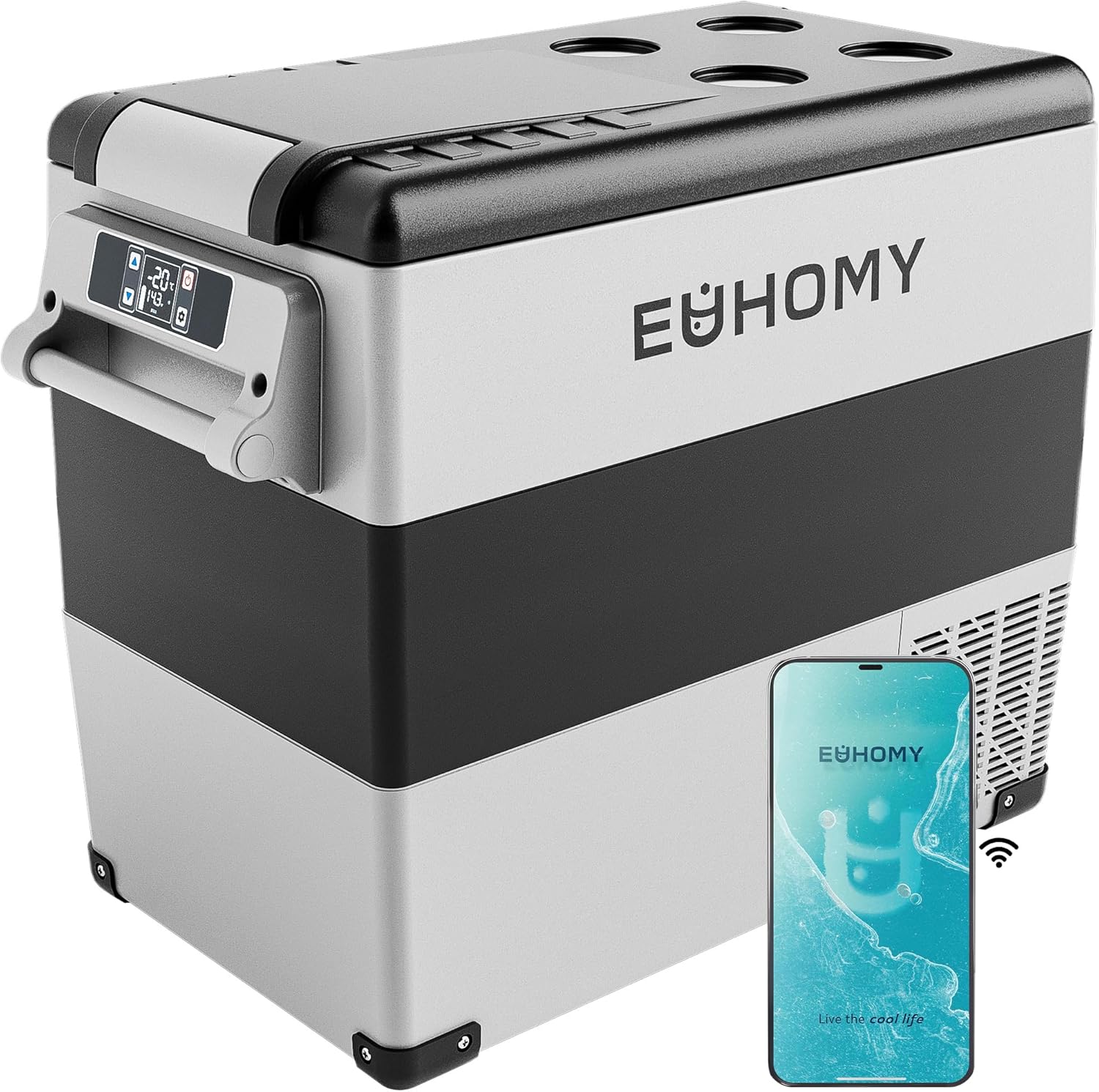
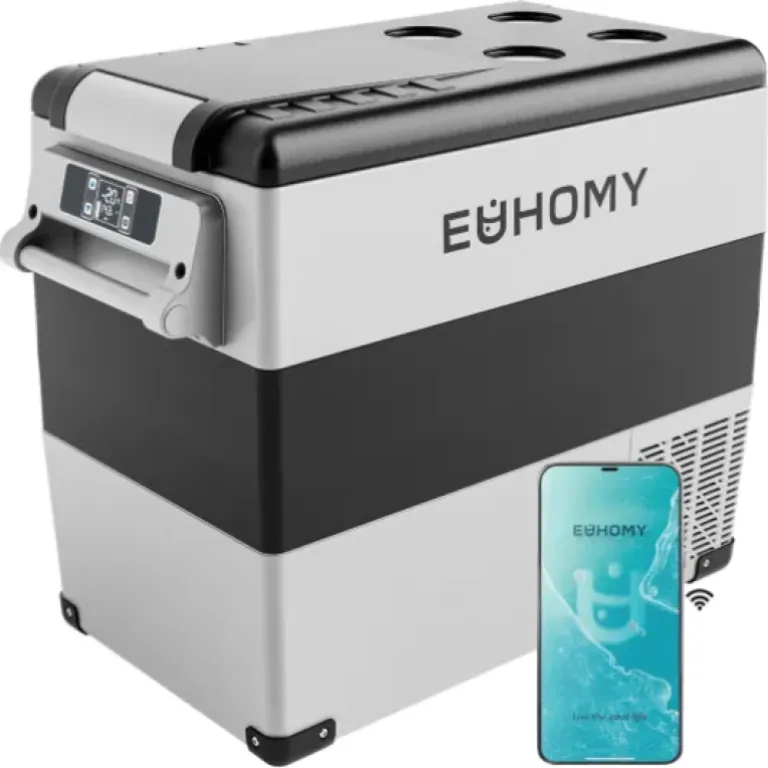
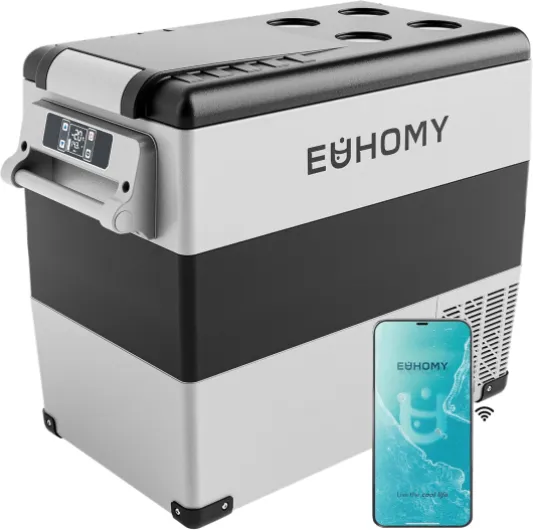
Design-wise, this thing is more about function than looks. It’s a long, fairly narrow box (about 27.4" x 13.8" x 21") that fits nicely along the side of an SUV trunk or across the back of a truck bed. The footprint is actually easier to work with than some chunkier models I’ve tried, because the narrower width leaves a bit of room for other gear. The lid opens from the top, and the hinge is reversible, but out of the box it’s set up in a way that worked fine for me in both the house and the car.
The handles on each side are probably the most important part of the design, and they’re decent. They’re removable, but I just left them on. With the fridge empty, the 33 lb weight is manageable. Once you load it with drinks and food, it becomes a two-person lift if you care about your back. There are no wheels, which is the main design miss in my opinion. If you’re moving it more than a few meters when it’s full, you’ll want a dolly or cart, especially on rough ground.
Inside, you get a removable wire basket in the main compartment and a smaller side area over the compressor. That side area does run warmer (around low 30s °F when the main is at 0°F), which I actually found useful for things you don’t want frozen: drinks, veggies, or stuff you plan to eat soon. Just don’t think of it as a fully independent fridge zone — it’s more like a warmer shelf. There’s also a small internal LED light, which sounds minor but is handy when you’re digging around at night.
The overall plastic shell and lid feel fairly sturdy but not high-end. When you plug in the power cable at the back, the plastic flexes a bit, which doesn’t inspire a ton of confidence if you’re rough with it. I just learned to plug it in gently and not yank the cord. The lid seal is okay; not as beefy as a high-end cooler, but good enough that it holds temperature reasonably well once cooled. So from a design standpoint: it’s practical, a bit plain, and clearly built with cost in mind, but it works.
Power use, battery protection, and real-world runtimes
I ran this fridge off three different sources: a car’s 12V outlet, a 1000Wh power station, and household AC. The included DC and AC cables both worked fine, though the DC cable doesn’t feel super premium and I wouldn’t abuse it. In terms of draw, on 12V DC I usually saw around 3–4 amps when the compressor was running in Eco, and closer to 4–5 amps in Max, so roughly 40–60W. Once the set temperature was reached, the compressor cycled, and average consumption dropped a lot. Idle draw when the compressor was off was about 1–3W, basically just electronics.
On my 1000Wh battery pack with the fridge set around 34–36°F and half full, I was able to get roughly 30–36 hours before the battery hit around 10–15%. That matches the long Amazon review claiming around a day and a half of runtime. Obviously, if you run it as a hard freezer at 0°F or below, or if it’s sitting in direct sun in a hot car, it’ll pull more power. On AC through an inverter, the reading was about 47W in use, but that includes the inverter overhead, so the fridge itself is closer to low-40s Watts on average when cooling.
The battery protection feature is actually useful, not just a checkbox. You can choose High, Medium, or Low cut-off. On a car battery, I kept it on High or Medium so it would shut down before draining the starter battery too far. The manual and one Amazon review even list the exact voltages, and they’re in a reasonable range. On a power station, I set it to Low so it would run longer. I didn’t have any surprise shutdowns as long as I picked the right mode for the power source.
So for power behavior: it’s efficient enough for long trips, especially if you pair it with a mid-size power station and maybe some solar. Just don’t expect to run it for days off a tiny jump pack. And remember this thing has no built-in battery, so you always need some external power source; it’s not a standalone cooler you can just charge and forget.

Durability: how it handles real use, bumps, and continuous running
In terms of durability, I put this fridge through what I’d call normal abuse for camping and road trips, not full-on overlanding torture. It rode in the back of an SUV over some rough forest roads, got moved in and out of the car a bunch of times, and ran almost non-stop for several days at a time. So far, the shell, handles, and lid all held up without cracks or obvious damage. The compressor seems fine with being jostled; it’s rated to handle up to a 30° tilt, and I definitely hit some angles close to that on rutted tracks without any shutdowns or error codes.
One user mentioned using it as a temporary home freezer for five days straight while their main fridge was dead, and I did something similar but for a shorter window. Running 24/7 on AC at 0°F didn’t seem to bother it. It stayed at temp, and the compressor didn’t overheat or throw any F2/F3/F5 errors. That gives me a bit more confidence that it’s not just designed for occasional use, even if it’s obviously not a full-on household appliance.
The weak points from a durability standpoint are mostly small things: the plastic flexing near the power jack, the basic DC cable, and the lack of a drain. The no-drain issue is more of a maintenance annoyance than a structural problem, but if you spill something inside or need to defrost, you’ll be wiping it out with a towel instead of just pulling a plug. Also, it’s not waterproof, so I kept it under cover when it rained; I wouldn’t trust it sitting out in a downpour.
Overall, I’d say the durability feels decent for the price point: the core components (compressor, insulation, shell) seem solid enough, but it’s still a plastic box that you shouldn’t throw around like a Pelican case. If you strap it down in the vehicle, lift it correctly, and don’t abuse the ports, I don’t see why it wouldn’t last several seasons of camping and road use.
Performance: cooling speed, temperature stability, and noise
On cooling performance, this fridge does what it says. From room temperature, I saw it go from around 70°F down to freezing (32°F) in roughly 20 minutes in Max mode, and to near 0°F within about 45–60 minutes, which lines up with the detailed user review you see on Amazon. The compressor is a variable speed type, so in Max it runs harder and louder, in Eco it’s slower and quieter but still keeps things cold once you’re at temp. For trips, I’d chill it at home on AC power before loading it, which helped a lot and cut down startup draw on my power station.
Once it’s at temperature, it cycles on and off. With the set point at 40°F, I saw the internal temperature (with my own thermometer) swing between about 36°F and 42°F in Max mode, which is fine for food safety. Eco has slightly bigger swings, but still okay for drinks and most food. When I ran it as a freezer at 0°F, it kept ice cream solid and meat rock hard over several days. The small shelf area stayed around 32–35°F while the main cavity was at 0°F, which is actually pretty nice if you want some items just chilled.
Noise-wise, the compressor is noticeable in a quiet room. It’s not insanely loud, but you’ll hear a hum and a slight vibration when it kicks in. In a car or outside at a campsite, it fades into the background. At home in a small apartment, you’ll be aware of it if it’s in the same room you sleep in. Once it hits target temp and cycles less often, it’s fine, but if you’re sensitive to noise, just don’t put it right next to your bed.
Overall, in terms of raw performance, it’s pretty solid: fast pull-down, stable temps, and enough cooling power to actually act as a real freezer, not just a glorified cooler. It’s not silent, and you do get some temp swings, but nothing that caused any food issues for me over multiple days of use.

What this EUHOMY fridge actually offers in real life
On paper, the EUHOMY 59QT is a 12/24V DC and 100–240V AC portable fridge/freezer with dual zones, Bluetooth app control, and a variable speed compressor. In real life, what that means is you get a big plastic chest with one main deep compartment (where the basket goes) and a smaller side ledge area that runs a bit warmer. You can run the whole thing as a fridge, or drop the temp low enough to turn most of it into a freezer while the smaller area stays more like a fridge. There isn’t any powered divider or true independent temperature zones; it’s more about how the cold air flows.
The control panel on the front is simple: power button, up/down arrows for temp, a settings button for Eco/Max and battery protection levels, and an LCD that shows your set temperature. The Bluetooth part works with an app (it’s branded Alpicool in the store), which lets you adjust temperature and modes from your phone. I used the app mostly to check the temp from inside the tent or from the driver’s seat without climbing into the back. It’s not fancy, but it works and paired quickly.
Capacity-wise, 59QT (about 55L usable) is big. For reference, I fit food for a family of four for a long weekend: meat, eggs, dairy, veggies, drinks — and still had space. Compared to a normal large cooler, you basically gain all the space that would normally be taken up by ice. For a solo traveler or a couple, it’s almost overkill unless you’re going on longer trips or like to stock a lot of frozen stuff.
Overall, the feature set matches what you actually get: a big cold box with basic smart controls, quick cooling, and enough flexibility to be a fridge or a freezer. There aren’t any hidden surprises like built-in batteries or fancy drawers. If you go in expecting a straightforward 12V fridge with some useful tech touches, it lines up with the product page pretty well.
Pros
- Strong cooling performance with true freezer capability down to around -4°F
- Large 59QT capacity that actually replaces ice-filled coolers for multi-day trips
- Reasonable power consumption with useful battery protection and both AC/DC included
Cons
- No wheels and heavy when full, so moving it can be awkward
- Build quality is decent but not premium; flex around power port and no drain hole
- Compressor noise is noticeable in quiet rooms, better suited to cars and campsites
Conclusion
Editor's rating
Overall, the EUHOMY 59QT 12V refrigerator is a pretty solid workhorse. It cools and freezes quickly, holds temperature well enough for both fresh food and frozen stuff, and doesn’t chew through power as badly as you might expect for the size. The big capacity is genuinely useful if you camp with family or do long road trips, and being able to ditch ice completely is a big quality-of-life boost. The app control and battery protection modes are practical features, not just marketing points.
It’s not perfect. The unit is heavy when loaded, and the lack of wheels makes moving it a bit of a chore. The compressor noise is noticeable in quiet indoor spaces, and the build quality, while decent, clearly targets a budget-conscious buyer. The smaller side compartment isn’t a true second zone, just a warmer shelf, so don’t buy it expecting a fully independent dual-zone system. Still, at this price, the trade-offs feel reasonable.
I’d recommend this fridge to campers, vanlifers, truckers, or anyone who wants a large 12V fridge/freezer without jumping into the higher-end brands. It’s also handy as a backup freezer at home during outages or appliance failures. If you want something ultra-quiet, super polished, or easier to move around solo, you might want to look at more expensive models with wheels and a sturdier build. But if your main priority is keeping food reliably cold or frozen and you’re okay with a few rough edges, this EUHOMY gets the job done for a fair price.