
Summary
Editor's rating
Taste and Texture of the Ice Cream You Get
Value for Money: Is It Worth Paying More Than a Freezer-Bowl Machine?
Design and Noise: Big, Heavy, but It Looks Decent
Build Quality and Durability After Regular Use
Performance: How Well It Actually Freezes and Churns
What You Actually Get with the Whynter ICM-200LS
Pros
- Built-in compressor means no pre-freezing bowls and allows back-to-back batches
- Consistent, creamy texture with properly chilled bases and decent 2.1-quart capacity
- Sturdy stainless steel build and simple, easy-to-understand controls with timer
Cons
- Bulky and heavy, needs permanent counter space or a good storage spot
- Motor protection can stop churning when mix gets very thick, requiring a quick stir
- Price is high if you only make ice cream occasionally

Specifications
View full product page →| Brand | Whynter |
Why I Ditched the Freezer-Bowl Ice Cream Maker
I’ve been using the Whynter ICM-200LS at home for several weeks now, and the main reason I bought it was simple: I was sick of those ice cream makers where you have to keep a giant bowl in the freezer 24/7. In real life, that bowl always ended up full of peas and pizza rolls, and when I actually wanted ice cream, the bowl wasn’t frozen or I’d already used it once. So I wanted a machine with a built-in compressor that I could just switch on and go. This Whynter is exactly that type of machine.
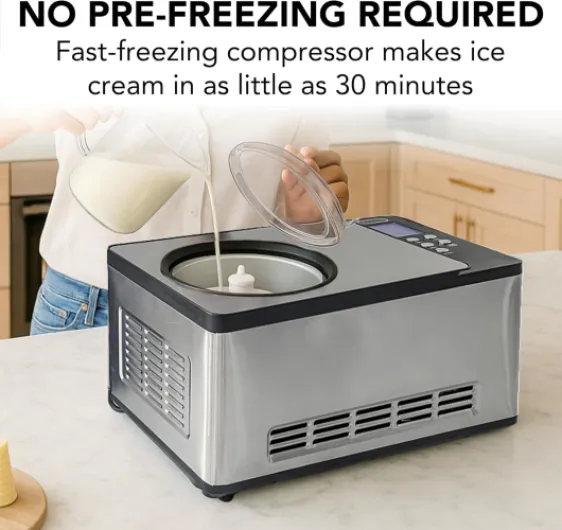
Out of the box, it feels like a small countertop appliance you’d see in a serious home kitchen, not a toy. It’s heavy, takes a bit of space, and it’s clearly not something you’re going to move in and out of a cabinet every day. The first evening I tried it, I went from cold mix in the fridge to a decent soft-serve texture in about 40 minutes, without any pre-freezing nonsense. That alone already made it more practical than my old Cuisinart freezer-bowl model.
In daily use, the big thing I noticed is that this machine actually gets used on weeknights, not just once a year. Before, making ice cream was this whole planned event: freeze the bowl overnight, make sure the freezer isn’t full, remember to do it ahead of time. With the Whynter, I can decide after dinner that I want ice cream, pour in a chilled mix, and that’s it. It’s not instant, but it fits into a normal evening without much planning. That’s the main difference in how often I actually make ice cream now.
It’s not perfect. It’s bulky, it’s not cheap, and it’s still an appliance you have to clean and store. But if you’re like me and you’ve had a cheaper machine gathering dust because it was a hassle, this one fixes a lot of those pain points. I’ll go through design, performance, taste, and whether I think the price is justified, based on using it for multiple batches of ice cream, sorbet, and one failed gelato experiment that still got eaten.
Taste and Texture of the Ice Cream You Get
Obviously the taste comes from your recipe, not the machine, but the texture and how it freezes do affect the overall experience. With this Whynter, when I use a standard custard base (eggs, cream, milk, sugar), I get a creamy, low-ice-crystal texture that’s honestly better than what I was getting out of my old freezer-bowl machine. The churn speed seems well-balanced: it incorporates enough air to keep things light, but not so much that it feels fluffy or fake. Vanilla, chocolate, and cookies-and-cream all came out smooth, with no crunchy ice bits as long as the base was fully chilled.
For sorbets and lighter mixes, it’s a bit more finicky. I made a lemon sorbet with a pretty high water content, and the first time I under-churned it, so it froze quite hard in the freezer later. The second time, I let it go a bit longer and it was better. So for sorbet, you want to push closer to the upper end of the time range. Still, the final result was bright and pleasant, and the texture was good once I found the right timing. So it can handle sorbet, just expect to tweak your process a little.
Mix-ins work fine, but you have to be smart about when you add them. I usually wait until the ice cream has thickened (around the 25–30 minute mark) and then add chopped cookies, chocolate chips, or nuts through the opening. The paddle distributes them reasonably well, but big chunks sometimes clump together. If you’re picky, you might want to fold in some extras by hand when you transfer the ice cream to a container. The machine itself doesn’t really care; it just has to keep turning without jamming.
Overall, the taste and texture you get are very good for a home machine. It doesn’t feel like a novelty gadget; the ice cream is something you actually want to serve to guests. It’s not on the level of a commercial gelato machine, obviously, but for casual home use, I was honestly satisfied. The main thing is that it doesn’t introduce weird ice crystals or uneven freezing, which is where cheaper setups usually fall short.
Value for Money: Is It Worth Paying More Than a Freezer-Bowl Machine?
Price-wise, the Whynter ICM-200LS sits well above those basic $60–$80 freezer-bowl ice cream makers, and below some of the higher-end Italian machines. So the real question is: is the extra cost justified by what you get? For me, yes, but with some conditions. If you only make ice cream once a year, this is overkill. You’d be better off with a cheap model or just buying ice cream at the store. The main value here is convenience and consistency if you actually use it often.
Compared to my older Cuisinart freezer-bowl unit, the biggest gain is that I don’t have to plan ahead or sacrifice freezer space to keep a bowl frozen at all times. That sounds minor, but in practice it’s the difference between using the machine regularly and letting it collect dust. The ability to do multiple batches in one evening without swapping bowls or waiting a day is also a real perk if you have a family or guests. Those two points alone are where the money goes, in my opinion.
On the downside, it’s a big, heavy appliance that you have to commit to storing somewhere. If your kitchen is tiny, this will feel like a burden. Also, it doesn’t magically make you a pro; you still need to chill your base, measure ingredients, and give it enough time. If you cut corners, you’ll still get mediocre ice cream, and then the price will feel steep. So the value depends a lot on your habits and expectations.
Overall, I’d say the value for money is pretty solid if you’re the kind of person who genuinely likes making homemade ice cream and plans to do it regularly. It’s not cheap, but it’s also not a silly luxury if you compare it to what people spend on other kitchen appliances like stand mixers or espresso machines. If you just want occasional novelty, save your cash. If you’re tired of freezer bowls and actually want a compressor machine without jumping to very high-end prices, this hits a reasonable middle ground.
Design and Noise: Big, Heavy, but It Looks Decent
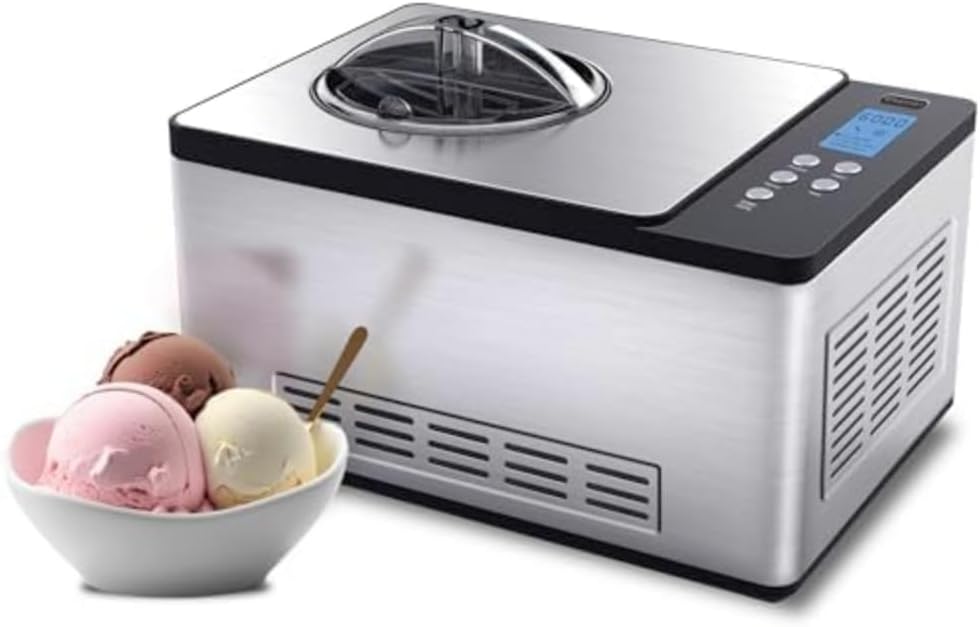
The design is pretty straightforward: a stainless steel box with vents on the sides, an LCD screen and soft-touch buttons on top, and a circular opening where the bowl and paddle go. The stainless steel looks clean and blends in fine with other kitchen stuff. It doesn’t scream “cheap plastic gadget,” which is nice. That said, it’s not small. At about 16.75" x 11.25" x 10.25" and around 24 pounds, it eats a good chunk of counter space. In my kitchen, it basically lives in one spot; moving it in and out of a cabinet would be annoying.
The controls are basic but clear. The LCD is readable, even under normal kitchen lighting, and the timer is easy to set in minutes. There are no complicated modes. You basically set a time (I usually do 40–60 minutes depending on the mix), hit start, and let it go. There’s an audible beep when it’s done. The beeper is loud enough to hear from another room but not so loud that it’s annoying. My only gripe is that the timer is just time-based, not temperature-based, so you still have to learn how your recipes behave and adjust.
Noise-wise, I’d put it at the level of a stove range hood on low or a quiet dishwasher. You definitely hear the compressor cycling and the paddle churning, but it’s not ridiculous. I can still watch TV in the next room without cranking the volume. If you’re sensitive to noise, you’ll notice it, but it’s not like an old window AC unit. During a 45-minute cycle, you just kind of forget it’s running after a while.
The only design detail that bugged me a bit is the lid and ingredient opening. You can add nuts or chocolate through the opening, but it’s not super wide, so bigger chunks need to be broken up. Also, because of the way the paddle sits, you sometimes get a bit of splatter when pouring mix in if you’re not careful. Minor thing, but you learn to pour slowly. Overall, the design is practical and sturdy, more “appliance” than “gadget,” which for this category is what I prefer.
Build Quality and Durability After Regular Use
Durability is hard to judge long-term, but I can at least talk about the build quality after repeated use. The unit feels solid. The stainless steel shell doesn’t flex, the buttons haven’t gotten mushy, and the bowl still fits snugly in place. The dasher is plastic, but it doesn’t feel flimsy. I’ve washed it by hand after every batch and there’s no visible wear or bending. The removable aluminum bowl cleans up easily, and I haven’t seen any scratching that affects performance.
The compressor and motor seem up to the task for regular home use. I’ve put it through multiple weekend runs, including back-to-back batches, and it hasn’t overheated or thrown any errors. The motor protection kicking in when the ice cream gets very thick is actually a good sign to me; it means the machine is designed to protect itself rather than just grind away until something breaks. It can be slightly annoying if you want a rock-hard texture straight from the machine, but from a durability standpoint, it’s a plus.
One thing to keep in mind is ventilation. This unit has vents on the sides and needs some space around it so it doesn’t overheat. If you cram it into a tight corner or up against a wall, you’re probably shortening its life. I leave a few inches on all sides when it’s running, and the body gets warm but not alarming. The fan noise is steady, not rattly, which usually means the internal components are mounted decently.
Given that this model has been around for years and still holds a good rating, I’m reasonably confident in the long-term reliability, but of course, any compressor-based appliance can fail down the line. It’s more complex than a simple freezer bowl. If you treat it like a real appliance—don’t drop it, don’t block the vents, and don’t ignore weird sounds—it feels like it should last. I wouldn’t call it indestructible, but it comes across as more solid than a lot of mid-range kitchen gadgets.
Performance: How Well It Actually Freezes and Churns
In terms of performance, the important question is: does it freeze the mix evenly and give you a good texture without constant babysitting? For me, yes, most of the time. With a properly chilled base (I keep mine in the fridge for at least 4 hours, ideally overnight), I usually get a soft-serve consistency in around 35–45 minutes. For a richer, egg-based custard, I sometimes go to 50–60 minutes. The texture straight out of the machine is soft, like soft-serve or slightly firmer. If you want scoopable, store-style firmness, you need to harden it in the freezer for a couple of hours, which is normal.
The built-in compressor holds temperature steadily enough that you can run back-to-back batches. I’ve done two in a row for a small gathering: one vanilla, one strawberry. The second batch took maybe 5–10 minutes longer to reach the same texture, probably because the machine was already warm from the first run, but it still handled it without drama. No need to re-freeze anything or mess with ice. That’s a big plus compared to the old-school freezer bowl units.
I did notice that the machine sometimes stops churning a little earlier than I would like when the mix gets thick, because of the motor protection. You hear it struggle a bit, then it cuts the paddle while the cooling can still run. In those cases, the edges of the ice cream are quite firm and the center is a bit softer. A quick stir with a spatula evens it out, but it’s something you should know. It’s protecting the motor, which is good, but it also means you can’t just ignore it completely if you’re pushing for a very firm texture in the bowl.
Overall, for home use, the performance is pretty solid. It gets the job done consistently as long as you do your part: chill the base properly, don’t overload the bowl past the recommended level, and give it a reasonable time. It won’t turn a warm mix into perfect ice cream in 20 minutes, so if you’re impatient and skip chilling your base, you’ll be disappointed. But used correctly, it delivers reliable results and lets you make multiple flavors in an evening without weird temperature issues.
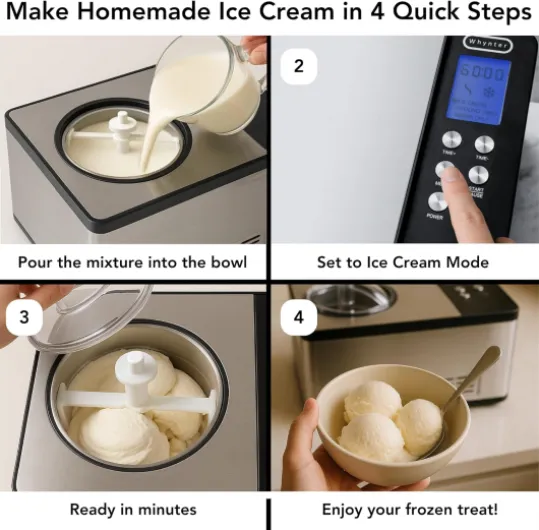
What You Actually Get with the Whynter ICM-200LS
On paper, the Whynter ICM-200LS is a 2.1-quart automatic ice cream maker with a built-in compressor, stainless steel body, and an LCD display with a timer. In practice, that means it’s a self-contained unit: you plug it in, pour in your chilled mixture, set the time, and it both chills and churns the ice cream for you. No ice, no salt, no pre-frozen bowl. Capacity-wise, 2.1 quarts is enough for a decent family batch. For my household of two adults and two kids, one run gives us dessert plus leftovers for the next day.
In the box you get the main machine, a removable aluminum mixing bowl, a BPA-free plastic dasher (the churn blade), a lid with an opening so you can add mix-ins, and a basic manual with some starter recipes. The manual isn’t fancy, but the instructions are clear enough. I used the included vanilla recipe as my first test and it worked fine. The interface is straightforward: power button, timer settings, and a start/stop button. No app, no Bluetooth, no nonsense, which I actually like for this type of appliance.
Function-wise, two features matter the most: the built-in compressor and the extended cooling mode. The compressor is what freezes the mixture, so you can run multiple batches in a row. The extended cooling mode keeps the finished ice cream cold and slightly churned for a bit after the timer ends so it doesn’t just melt and refreeze into a brick if you forget about it for a few minutes. There’s also a motor protection feature that basically stops the churn when the mix gets too thick, so you don’t burn out the motor by trying to make concrete.
Overall, the “feature list” on the box matches what you get in real life. It’s a fairly simple machine with a compressor and a timer, not some smart gadget with ten modes. If you want something that looks good, makes about 2 quarts at a time, and doesn’t require planning a day in advance, this is the general package you’re signing up for. No surprises there, which I appreciate.
Pros
- Built-in compressor means no pre-freezing bowls and allows back-to-back batches
- Consistent, creamy texture with properly chilled bases and decent 2.1-quart capacity
- Sturdy stainless steel build and simple, easy-to-understand controls with timer
Cons
- Bulky and heavy, needs permanent counter space or a good storage spot
- Motor protection can stop churning when mix gets very thick, requiring a quick stir
- Price is high if you only make ice cream occasionally
Conclusion
Editor's rating
Overall, the Whynter ICM-200LS is a practical, no-nonsense ice cream maker that actually fits into normal life. The built-in compressor and 2.1-quart capacity make it much easier to use than the classic freezer-bowl machines. You plug it in, pour in a chilled mix, and about 40–60 minutes later you’ve got soft-serve style ice cream that tastes and feels like something you’d be happy to serve to friends. It’s not perfect, but it does what it’s supposed to do without a lot of drama.
This is a good fit if you like the idea of making ice cream regularly, want to control your ingredients, and are willing to give it some counter or storage space. Families, people who host dinners, or anyone who’s already into cooking will probably get their money’s worth. If you’re expecting instant results from a warm mix, or you only make ice cream once or twice a year, it’s probably too much machine for you and the price will feel high. Also, if you’re extremely tight on space, the size and weight could be a deal-breaker.
If I had to sum it up: pretty solid performance, decent build quality, and way more convenient than the cheaper pre-freeze models. Not the cheapest option, not the fanciest, but a good middle-ground compressor machine that actually gets used instead of living in a cupboard. For my use, I’m satisfied and I’d buy it again, knowing exactly what it is and what it isn’t.