
Summary
Editor's rating
Value for money: where it sits versus pricier compressor machines
Design: looks decent, but it’s bigger and louder than it seems
Build quality and materials: mostly plastic, but feels sturdy enough
Durability and upkeep: treat the bowl right or you’ll regret it
Performance: soft-serve in ~25 minutes if you prep correctly
What you actually get and how it works in real life
How good is the ice cream really? Taste and texture in day-to-day use
Pros
- Consistently makes smooth, soft-serve style ice cream in about 25–30 minutes when used correctly
- Large 2-quart capacity is enough for a family or small gathering in one batch
- Simple operation (on/off only) and sturdy build make it easy to live with and hard to mess up
Cons
- Requires freezing the bowl 12–24 hours in advance, so no spontaneous batches
- Quite loud while running, noticeable in an open kitchen/living space
- Freezer bowl is hand-wash only and can be ruined by a dishwasher or very hot water

Specifications
View full product page →| Brand | Cuisinart |
A simple machine that finally got me to make ice cream at home
I’ve been eyeing this Cuisinart ICE-30BCP1 for a while, mostly because store ice cream keeps getting pricier and the ingredient lists keep getting longer. I’m not a chef, I just wanted a straightforward way to make decent ice cream and sorbet at home without a lot of drama. I’ve used the smaller 1.5-quart version before at a friend’s place, so I had a rough idea of what to expect, but I wanted more capacity and my own unit to beat up regularly.
Over a few weeks, I ran several batches through it: classic vanilla, a chocolate version, a coconut-milk vegan attempt, and a couple of fruit sorbets. I also tested how annoying it is to clean, how loud it gets, and how much freezer space that bowl actually eats. So this isn’t a one-time use review; it’s more like the opinion of someone who’s actually lived with the thing in a normal kitchen.
The short version: it’s not magic, but it works consistently as long as you respect its limits. You do need to plan ahead (that freezer bowl is not your friend if you’re impulsive), and it’s louder than you’d think from the photos. But once you understand how it behaves, getting a good batch is pretty easy, and it’s way better than the old salt-and-ice bucket style machines I used before.
If you’re expecting rock-hard, scoopable ice cream straight from the machine, you’ll be disappointed. It gives you soft-serve texture in about 25–30 minutes, and then you finish it in the freezer. If you’re okay with that and you’ve got enough freezer space, this thing is pretty solid for the price.
Value for money: where it sits versus pricier compressor machines
On price, this sits in that mid-range sweet spot for home ice cream makers. It’s more expensive than the tiny novelty units and old-school salt-and-ice buckets, but way cheaper than compressor machines that cool themselves. Those can easily be four or five times the price. So you’re basically paying for a decent motor and a big 2-quart insulated bowl, not a built-in freezer.
If you only make ice cream twice a year, honestly, you’re probably better off just buying good store brands. Where this starts to make sense is if you have dietary restrictions (dairy-free, gluten-free, no refined sugar, etc.), kids who eat a lot of ice cream, or you just like experimenting with flavors. Then the cost per batch drops and the flexibility is nice. You control the ingredients and can avoid all the stabilizers and gums if that matters to you.
Compared to the smaller 1.5-quart Cuisinart, the 2-quart size is actually useful. You can make enough for a family or for a small gathering in one shot. I used to have to run two cycles on smaller machines to feed everyone, which is annoying because the bowl warms up after the first batch. With 2 quarts, one run is usually enough.
So in terms of value, I’d call it "good but not crazy cheap." You’re paying for reliability and simplicity more than features. If you want push-button hardening, built-in chilling, and perfect texture on demand, you’ll need to shell out for a compressor model. If you’re okay freezing a bowl and doing a bit of planning, this Cuisinart gives you solid results for a fair price.
Design: looks decent, but it’s bigger and louder than it seems
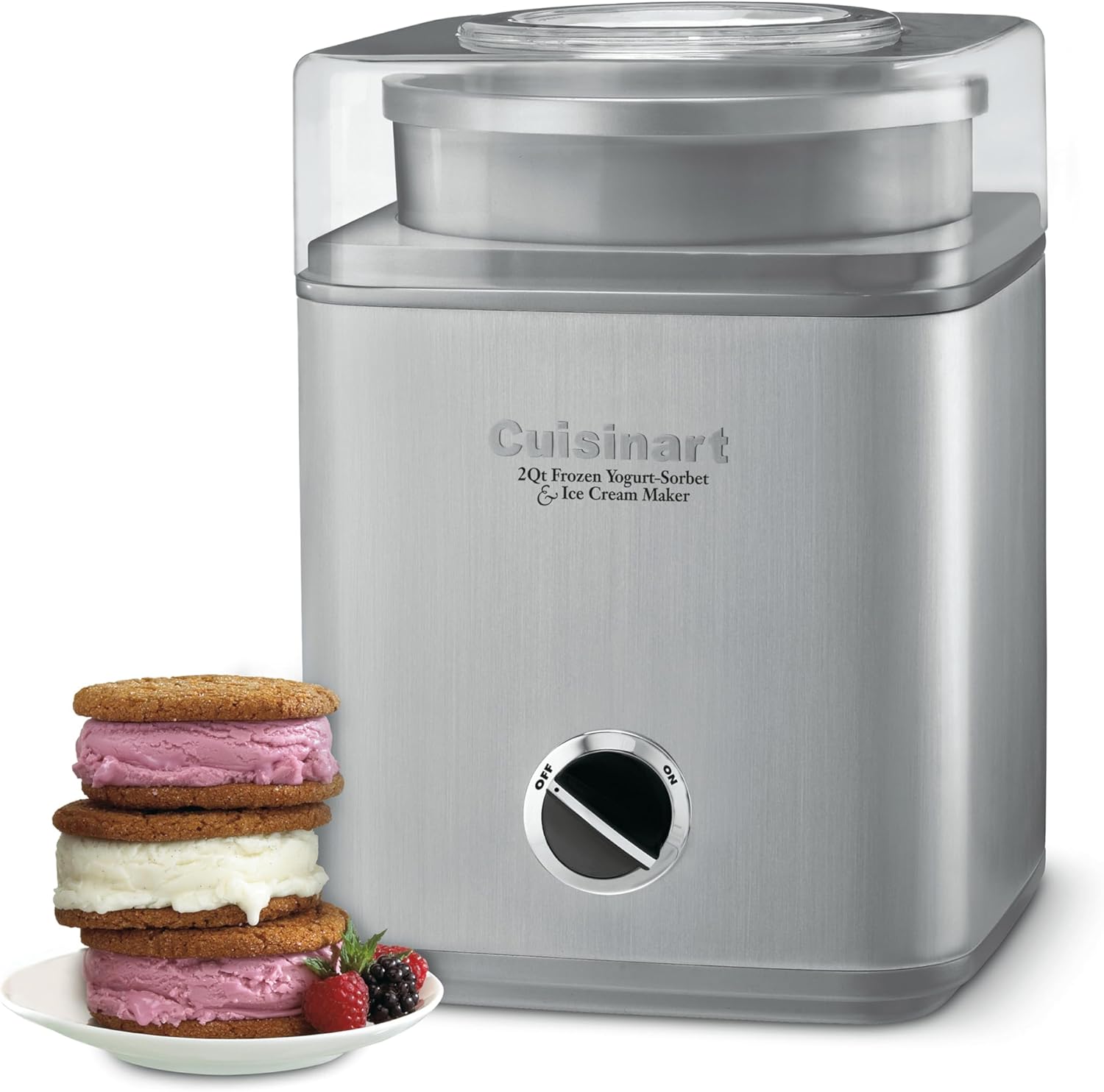
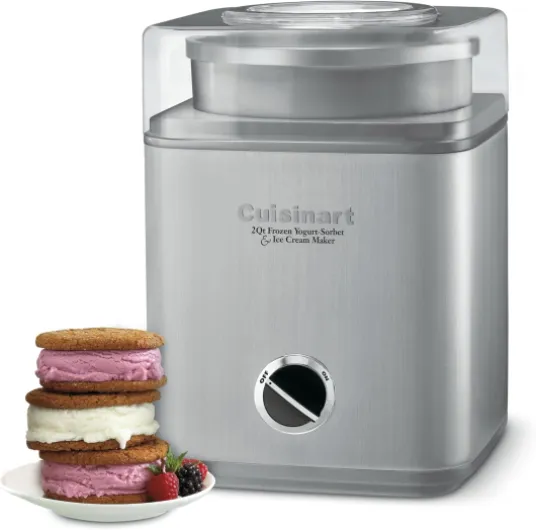
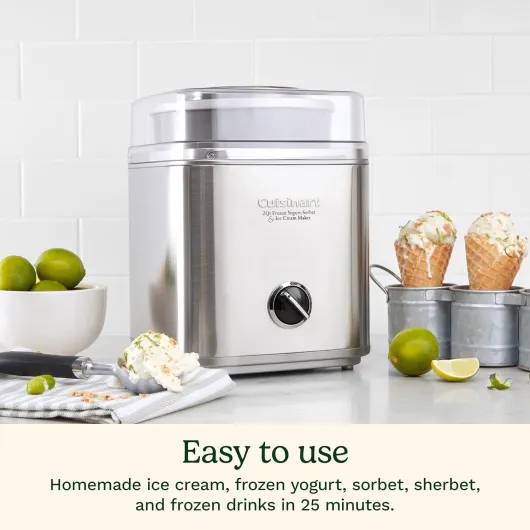
Visually, it’s pretty straightforward: brushed stainless look on the outside, plastic trim, and a clear lid. On the counter, it looks fine – not fancy, not cheap. It’s heavier than it looks (around 12 pounds), which I actually liked because it doesn’t slide around while churning. You can stick it in a corner and it will stay put. The footprint is reasonable, but it is still a chunky appliance. If you have a tiny kitchen, you’ll feel it.
The control "interface" is just a rocker switch: on or off. No timer, no beeps, nothing. At first I thought I’d miss a timer, but honestly, after a couple of uses you just glance at the texture and you know when it’s done – when the paddle starts to struggle and the ice cream climbs up a bit, it’s ready. I just use my phone timer if I want to track the 25–30 minutes.
The lid design is okay. The ingredient spout is wide enough to dump in chocolate chips, nuts, or cookie chunks without making a mess. One thing I noticed: if you overfill the bowl with mix, it can creep up close to the lid and make scraping it out a little messy. So sticking to that 2-quart max (actually more like 1.5–1.75 quarts of liquid mix) is smart. There’s also retractable cord storage in the base, which is a small detail but handy if you hate cords hanging everywhere.
The biggest design downside is the noise. When it’s running, it’s definitely not quiet. It sounds like a small stand mixer or an older food processor on low – not ear-splitting, but if your kitchen is open to your living room, you’ll hear it. For a 25–30 minute cycle, it’s tolerable, but if someone’s trying to watch TV nearby, they’ll comment on it. So yeah, don’t expect a whisper-quiet device here.
Build quality and materials: mostly plastic, but feels sturdy enough
The outer shell is brushed stainless steel, but a good chunk of the machine is plastic: the lid, paddle, and parts of the base. The freezer bowl has that metal outer wall with the coolant sealed inside. Overall, it feels solid for a home appliance in this price range. It’s not commercial-grade, but it doesn’t feel flimsy either. After several batches, I didn’t see any cracks, warping, or weird rattling.
The paddle is pretty basic white plastic. It does flex a bit when the mix thickens, which is normal. Some people complain that these paddles don’t scrape the bowl as tightly as a professional machine, and that’s true – you’ll sometimes have a thin frozen layer stuck to the bowl that you scrape off by hand when you’re done. For home use, I don’t see it as a big issue, but if you’re picky, you’ll notice it.
The freezer bowl is the part you absolutely have to treat carefully. The manual is clear: no dishwasher, no super hot water, no sharp tools. If you ignore that and toss it in the dishwasher, you basically kill the coolant inside and the bowl never freezes properly again. I’ve seen that happen with a friend’s older Cuisinart bowl. I washed mine by hand with lukewarm water and a soft sponge, and it’s still freezing like it should. So yeah, this is one of those parts you baby a little.
For the price, the materials are fine. You’re not getting full metal internals or anything, but the heavy base and decent fit and finish give the impression it’ll last if you don’t abuse it. I’d say it feels like a "pretty solid" mid-range kitchen appliance, not high-end, not junk. If you want a tank, you’re looking at the much pricier compressor machines.
Durability and upkeep: treat the bowl right or you’ll regret it
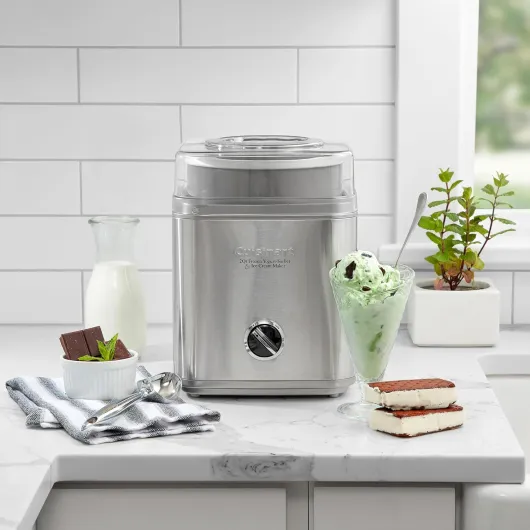
Durability-wise, there are a couple of things to know. The base and motor feel like they’ll last for years under normal home use. You’re not running this thing daily in a restaurant; most people will probably use it once a week at most. I ran multiple back-to-back batches over a few weekends, and the motor never overheated or gave weird smells. The housing still looks the same aside from some fingerprints on the stainless part.
The weak point, as many people mention, is the freezer bowl. It’s not fragile in the sense of cracking easily, but it’s sensitive to heat and rough treatment. If you put it in a dishwasher or soak it in very hot water, you risk ruining the coolant inside. Once that happens, it never freezes properly again, and all your batches will stay soft or slushy. That’s not really a design flaw, more just how these sealed coolant bowls work, but you do need to be aware of it.
Cleaning is straightforward. You can’t submerge the base, obviously, so you just wipe it down. The lid and paddle are easy to wash in the sink. The bowl needs gentle hand washing and then a full dry before going back into the freezer. After each batch, I let it warm up a little so I’m not shocking it with water, then I rinse and wipe it. It’s a bit of a routine, but not a huge chore.
Given the number of positive long-term reviews and my own use so far, I’d say it’s built well enough for regular home use. Just don’t expect it to survive kids throwing the bowl into the dishwasher or dropping it on a tile floor. If you’re reasonably careful, it feels like something that can easily last several years.
Performance: soft-serve in ~25 minutes if you prep correctly
On performance, it basically does what Cuisinart says, but only if you follow a few rules. When I froze the bowl overnight and used a fully chilled mix (straight from the fridge, not lukewarm), I got soft-serve texture in about 20–30 minutes every time. Vanilla and chocolate mixes with decent fat content thickened the fastest, around 22–25 minutes. Sorbets and lighter mixes took closer to 30 minutes.
If anything is off – bowl not frozen enough, mix too warm, or you overload the bowl – you’ll get disappointing results. One time I poured in a mix that was just cooled to room temp, not fridge-cold, and after 30 minutes it was more like a slushy. Same with an overfilled bowl: the machine still churns, but the texture isn’t as dense and creamy. So the machine is not very forgiving if you’re lazy with prep, but that’s just how this style of freezer-bowl machine works.
The motor handled thicker mixtures fine. As the ice cream firms up, you can hear it working harder, but I never had it stall or shut down. For a 2-quart home unit, that’s decent. Just don’t walk away for an hour; once the ice cream is thick, the motor is basically fighting a frozen mass. When it clearly stops changing texture and the paddle is struggling, flip it off and transfer the batch.
End result quality is good as long as your recipe is solid: creamy texture, no big ice chunks if you’ve chilled everything well. It won’t give you rock-hard ice cream straight out of the machine, but that’s normal. I’d say expect soft-serve from the machine, then good scoopable texture after 3–4 hours in the freezer. For home use, that’s perfectly fine. It gets the job done without fuss once you know its quirks.
What you actually get and how it works in real life
Out of the box, the ICE-30BCP1 is pretty simple: base with motor, a double-insulated freezer bowl, plastic paddle, and a lid with a big ingredient spout. That’s it. No screen, no timer, no fancy modes. There’s literally just an on/off switch. If you like gadgets with lots of settings, this will feel barebones. Personally, I liked that there wasn’t much to fiddle with – less to break, less to overthink.
The important part is the freezer bowl. This is not a compressor machine; it doesn’t cool itself. You have to freeze the bowl for at least 12–24 hours. When it’s properly frozen, you don’t hear any sloshing if you shake it. First time I rushed it with only ~10 hours in a regular fridge-freezer and my mix turned into a cold soup instead of ice cream. When I gave it a full overnight in the coldest spot, it worked like it should.
In practice, the workflow is: make your ice cream base in advance, chill it in the fridge until it’s really cold, freeze the bowl overnight, then assemble, turn it on, and pour the mix in while it’s spinning. Within 20–30 minutes, you get a soft-serve consistency. You can eat it right away if you like softer ice cream, or move it to a container and freeze it a few hours for a more standard texture.
The machine doesn’t take much brainpower, but it does require planning. If you’re the type who suddenly craves ice cream and wants it in 15 minutes start-to-finish, this style of machine will annoy you. If you’re okay with prepping the day before or keeping the bowl permanently in the freezer, then the simplicity is actually pretty nice.
How good is the ice cream really? Taste and texture in day-to-day use
In terms of actual results, I was pretty happy. The machine itself doesn’t "add" taste, obviously, but it does affect texture a lot. With a standard custard base (eggs, cream, milk, sugar), the ice cream came out smooth and fairly dense. Straight from the machine, it’s like soft-serve from a mall. After a night in the freezer, it firms up to a regular store-like scoop, maybe a bit harder depending on how much fat and sugar you used.
Compared to store ice cream, the big difference is air. This machine doesn’t whip in as much air as cheap supermarket brands, so your homemade stuff feels richer and heavier. That’s good from a taste point of view, but it also means it can feel quite firm straight from the freezer. I had to let a few batches sit on the counter for 5–10 minutes before scooping. Using more cream and a bit more sugar helps keep it softer. One Amazon reviewer’s note about fat and air content is spot on.
Sorbet came out surprisingly smooth. I tried a mango sorbet and a berry one, both with simple sugar syrup. Before this machine, my sorbets were icy and grainy. With the Cuisinart, as long as the bowl and mix were really cold, the texture was much finer. Still not like a high-end gelato shop, but definitely a step up from what I was doing with a basic freeze-and-stir method.
For vegan or allergy-friendly recipes, I tried a coconut-milk base with a bit of starch, similar to the recipe from one of the reviews. It worked well: very creamy, but it does freeze a bit harder, so you really want to let it sit out a few minutes before serving. The machine itself doesn’t care if you use dairy or not; as long as the base is chilled and not too watery, it churns it into something quite decent. So from an effectiveness standpoint, it covers ice cream, frozen yogurt, and sorbet just fine.
Pros
- Consistently makes smooth, soft-serve style ice cream in about 25–30 minutes when used correctly
- Large 2-quart capacity is enough for a family or small gathering in one batch
- Simple operation (on/off only) and sturdy build make it easy to live with and hard to mess up
Cons
- Requires freezing the bowl 12–24 hours in advance, so no spontaneous batches
- Quite loud while running, noticeable in an open kitchen/living space
- Freezer bowl is hand-wash only and can be ruined by a dishwasher or very hot water
Conclusion
Editor's rating
Overall, the Cuisinart ICE-30BCP1 is a straightforward, no-frills ice cream maker that does what it says as long as you respect its limitations. It’s not compact, it’s not quiet, and it definitely requires planning because of the freezer bowl. But when you freeze the bowl properly and chill your mix, it turns out consistently good ice cream, sorbet, and frozen yogurt in about half an hour. Texture is smooth, closer to soft-serve at first, and it firms up nicely after a few hours in the freezer.
This is a good fit for people who like to cook at home, families that go through a lot of frozen desserts, or anyone dealing with allergies and special diets who is tired of paying for niche store-bought pints. If you want to control sugar, fat, or avoid dairy, this machine gives you that flexibility without needing a super expensive compressor unit. It also feels sturdy enough for regular use, as long as you don’t abuse the freezer bowl.
Who should skip it? If you’re tight on freezer space, hate planning ahead, or are very sensitive to noise, you’ll probably find it annoying. In that case, either stick with store ice cream or save up for a compressor machine that doesn’t need a frozen bowl. For everyone else who just wants a reliable 2-quart workhorse and is okay with a bit of prep, this Cuisinart is a pretty solid choice and decent value for the money.