
Summary
Editor's rating
Is it worth the money, or just a pricey toy?
Big, flashy, and not something you hide in a cabinet
Ease of use, cleaning, and day-to-day hassle
Build quality and what it’s actually made of
How it holds up over time
How it actually performs with real parties and real drinks
What this machine actually does (beyond looking cool)
Pros
- Consistent frozen drink texture thanks to separate ice shaving and blending
- Three 24 oz pitchers with independent controls let you make multiple drink types at once
- Rotating ice chute and design create a fun, bar-like centerpiece for parties
Cons
- High price for something that’s mainly useful if you host parties often
- Recipe book is weak and requires a lot of tweaking to get good-tasting drinks
- Bulky, heavy, and a bit of a hassle to clean around the chute and blades

Specifications
View full product page →| Brand | Margaritaville |
A big, loud toy for people who really like frozen drinks
I’ve had the Margaritaville Tahiti Margarita Machine (DM3000) at home for a while now, and the short version is this: it’s basically a bar toy for people who throw real parties, not just “two friends and a bag of chips” nights. It takes up a chunk of space, makes a bit of noise, and feels overkill if you only drink frozen cocktails twice a year. But when you actually use it with a group, you start to see why people rate it so highly.
My usual setup before this was a regular blender and a bag of ice. It worked, but the drinks were inconsistent: sometimes chunky, sometimes too watery, and if you wanted to switch from margaritas to smoothies you had to rinse the jar and start again. With this machine, you load the ice in the top, fill the three pitchers with different mixes, and let it shave and blend automatically. It’s not magic, but it’s a lot more consistent than a cheap blender.
The other thing that surprised me is how much of a “show” it is. The rotating ice chute with the lights sounds gimmicky, but people really do stand around it watching it spin and dump ice into each pitcher. The guys especially seem glued to it like it’s a new grill or a power tool. If you’re more about quiet drinks on the couch, that whole vibe might feel a bit much, but for a lake house, deck, or pool party, it fits right in.
It’s not perfect though. It’s heavy, it’s not cheap, and if you expect to just follow the included recipes and be done, you’ll probably be disappointed. You need to tweak your mixes, practice a bit, and accept that it’s more of a dedicated frozen drink station than a general kitchen appliance. If that sounds fun and you host a lot, it makes sense. If not, you’re paying a lot for a big gadget you’ll rarely use.
Is it worth the money, or just a pricey toy?
This is not a budget appliance. You’re paying a premium for three pitchers, the rotating ice system, and the whole Margaritaville branding. If you only make frozen drinks a couple of times a year, honestly, it’s probably overkill. A decent mid-range blender and some trial-and-error with ice ratios will get you something drinkable for a fraction of the price. So from a pure practicality standpoint, no, this isn’t the most rational purchase for casual use.
Where the value starts to make sense is if you host often and actually use it. For lake houses, beach houses, decks, and regular summer parties, it becomes more justifiable. You’re buying not just the function, but the convenience of three pitchers at once and the guaranteed texture. Being able to run kids’ smoothies on one side and adult margaritas on the other, without washing jars in between, is genuinely handy. Also, the “show” factor is real. People notice it, talk about it, and tend to remember the party as “the one with that big margarita machine.” If that kind of thing matters to you, it adds value beyond just the drinks.
Compared to cheap ice shavers or $50 blenders, the difference in build and performance is clear. The DM3000 is faster, less messy, and does a better job managing melted ice water thanks to the reservoir. You’re also less likely to end up with ice chunks or weak, watery drinks, as long as your recipes are right. On the downside, you still have to invest time in dialing in mixes because the included recipes are mediocre. So you’re paying a high price, and you still need to do some work.
My take: if you’re budget-conscious or rarely entertain, skip it. There are better ways to spend the money. If you regularly have groups over, especially at a place where frozen drinks fit the vibe, and you like having a dedicated bar gadget that looks the part and gets the job done, then the price starts to feel more justified. It’s not cheap, but for the right type of user, it ends up being a pretty solid buy rather than just a silly splurge.
Big, flashy, and not something you hide in a cabinet
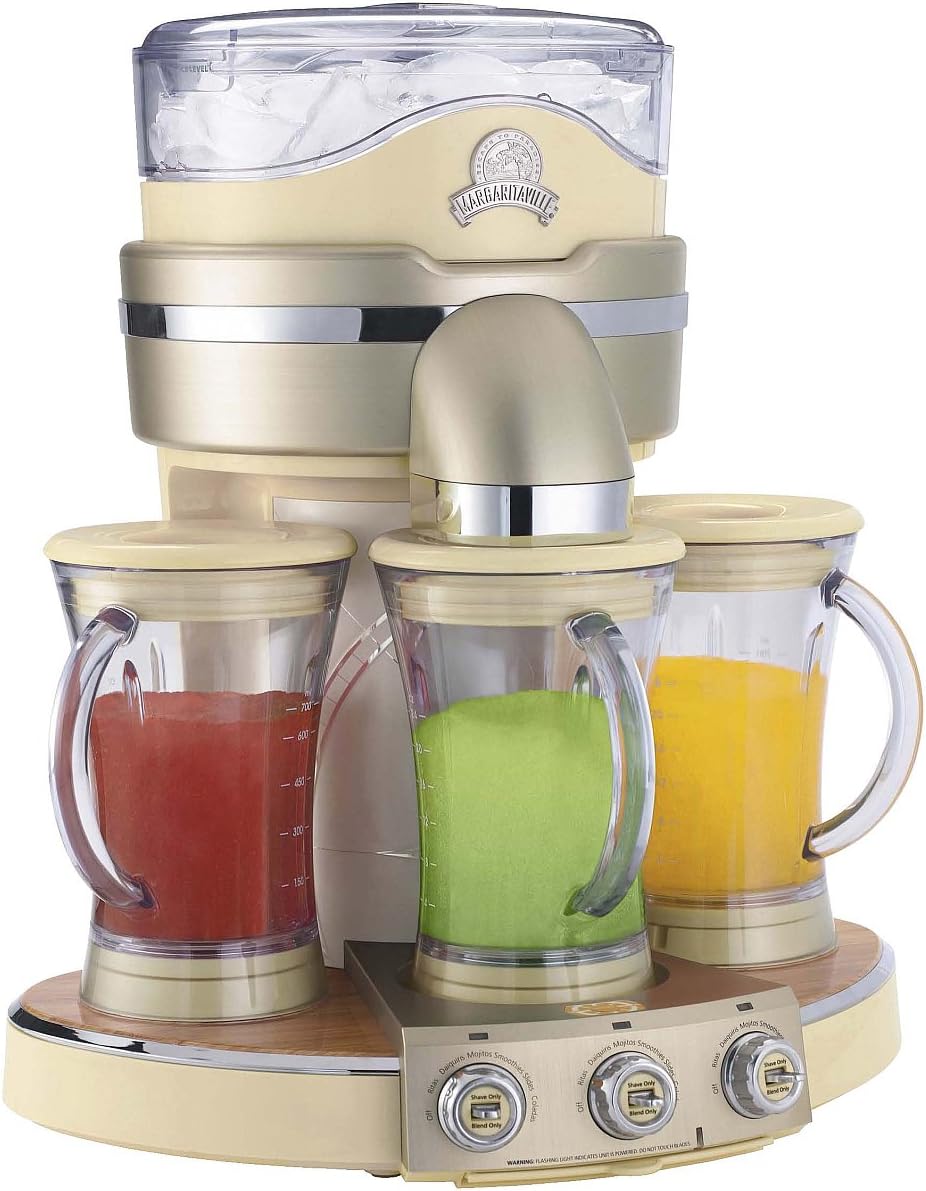
Design-wise, this thing is closer to a small appliance you’d see in a beach bar than a standard kitchen gadget. It’s about 19.5 x 19.5 x 19.34 inches and weighs around 20 pounds, so it’s not sliding easily under a cabinet or in a tiny apartment kitchen. It has an ivory body with bamboo wood and brushed aluminum accents, plus polished stainless steel parts. In real life, it looks like a themed bar piece, not a neutral kitchen blender. If you like the Margaritaville / Jimmy Buffett vibe, you’ll probably smile every time you see it. If you like minimalist, all-black gear, it might feel a bit cheesy.
The rotating ice chute with lights is pure show, and it works as intended. When the machine is running, the top section rotates, lines up with each pitcher, drops shaved ice, and then moves on. People notice it right away. At my place, the guys all end up hovering around it talking about how it works, comparing it to old blenders, etc. From a functional standpoint, the rotation is smooth enough, but the chute area does feel a bit delicate when you move it by hand for cleaning, so you don’t want to be rough with it.
The control layout is pretty simple once you’ve used it a couple of times. Each of the three stations has its own toggle to add more ice or blend more. There’s a big selector for drink type and a start button for the auto cycle. The manual labels and instructions are not the clearest in the world, especially for the side pitchers and how the top rotates automatically, so you need a couple of test runs to really get it. Once you’ve done that, it’s basically muscle memory.
The main downside of the design is the space and storage. It’s not something you casually move in and out for a single drink. Most people either leave it out on a bar, on a deck under a roof, or give it a dedicated shelf. If you have a small kitchen or hate cluttered counters, this will annoy you. But if you have a lake house, patio bar, or a basement bar area, it actually fits the environment well and looks like it belongs there.
Ease of use, cleaning, and day-to-day hassle
Using the machine is not hard, but it’s not as brainless as a one-button blender either. The basic flow is: fill the ice hopper, pour your pre-mixed liquid into the pitchers, choose the drink setting, and hit start. The first time, the manual is a bit confusing, especially around how the side pitchers get filled and how the top rotates automatically. After two or three runs, it clicks, and you’ll barely think about it. Still, I’d recommend doing a practice session before using it for an event. It’s better to mess up a batch alone than in front of a thirsty crowd.
The pitchers are easy enough to handle. Just remember to take the lid off before you pour; it sounds obvious, but it’s easy to forget when you’re rushing. Each pitcher has its own toggle to add more shaved ice or just blend again, which is handy when you’re trying to adjust texture for different people—some like thicker, some like more liquid. The machine isn’t physically hard to move, but at 20 pounds and with that bulky footprint, you probably won’t be dragging it in and out every night. It’s more of a “leave it on the bar” kind of thing.
Cleaning is where you feel the downside of the design. The pitchers themselves are simple to rinse and wash. The tougher part is the underside of the ice chute and the area around the shaving blade. Seeds from frozen fruit and bits of ice can get stuck on the lip and inside. To clean it properly, I ended up doing what other users suggested: lay the machine on its back, hold the chute steady with one hand, and wipe with the other using a cloth or wipes. You need to be very aware of where the blade is and not get casual with your fingers in there.
If you’re okay with a bit of post-party cleanup, it’s manageable. It’s not a two-minute rinse-and-done situation, but it’s not a nightmare either. I’d say it’s similar to cleaning a more complex coffee machine or espresso setup: some awkward spots, but once you know the routine, it’s part of the process. If you’re someone who hates any extra cleaning and likes ultra-simple gear, this will annoy you. If you’re already used to cleaning grills, smokers, or bar gear, it’s just another step in the ritual.
Build quality and what it’s actually made of
The materials are better than what you see on cheap ice shavers, but it’s still not an indestructible commercial unit. The frame uses premium bamboo wood, brushed aluminum, and polished stainless steel accents, with heavy-duty die-cast components in the areas that matter. The blades are stainless steel, and they are legitimately razor sharp. I lightly tapped one while cleaning and immediately understood why people keep warning about fingers near the blades. You do not want to scrape that with your hand.
The ice hopper on top feels solid and can hold about a full gas-station bag of ice. The machine is rated at 700 watts of combined shaving and blending power, which in everyday use feels like more than enough. It doesn’t bog down with normal ice cubes, but it does choke a bit if you throw in large fused chunks of ice (like a 3-inch block from a half-melted bag). If that happens, you just have to break the ice up a bit first. Bagged ice that’s slightly melty works best, and that matches what the instructions suggest.
The pitchers themselves are decent but not bulletproof. They’re fine for frequent use, but I wouldn’t treat them like industrial bar pitchers. The pitcher lids lock on well enough to avoid big messes during blending, but you do need to respect the fill line. If you try to be clever and overfill to "get more out of one batch," you’ll end up with overflow running down the sides once it starts blending at full power. The machine is strong enough that the liquid level rises a lot during blending.
Overall, the materials and build feel pretty solid for home use. It’s not flimsy, and it doesn’t feel like a toy when you pick it up. Just don’t confuse it with a stainless steel commercial margarita machine that runs all day in a bar. For what it is—a higher-end home frozen drink station—the metal components, sharp blades, and general construction make sense. You just need to be careful cleaning around the chute and blades and accept that a few areas, like the underside of the chute, feel a bit more fragile and need a gentle touch.
How it holds up over time
In terms of durability, this doesn’t feel like a fragile toy, but you do need to respect it. The 700-watt motor has enough power to handle regular use without sounding strained. I’ve run it through several parties in a short period—multiple cycles back-to-back—and it didn’t overheat or start smelling like burning electronics. Other long-term users (years, not weeks) report still using it regularly, which is a good sign for a product that’s been around since 2008 and still sells.
The parts that concern me more are the moving and thinner bits: the rotating chute, the hinge points, and the pitchers. The chute feels slightly delicate when you’re cleaning under it, so if you’re rough or twist it too hard, I could see that being a failure point. The pitchers are sturdy enough but still plastic; drop them on concrete or slam them around and you’ll probably crack one eventually. Treat the machine like a decent piece of bar equipment, not like a steel toolbox, and you should be fine.
One interesting detail from another user: they leave the machine outside on a covered deck, unplugged, even during storms. It gets some moisture from sideways rain but has held up fine with a wipe-down before use. I wouldn’t recommend full outdoor exposure or letting it sit in direct rain, but it does suggest the build can handle some real-world abuse and isn’t super sensitive to a bit of water or humidity. Just common sense: don’t leave it soaked, don’t plug it in wet, and dry it properly.
There’s a limited 1-year warranty, which is standard but not generous. For the price, I’d have liked a bit longer, but given the user reviews over many years and its rating, it seems to last for most people. If you’re planning to use it heavily every summer and for bigger gatherings, I’d say it’s solid enough to justify the cost as long as you’re not careless with the moving parts and blades. If you’re rough on appliances in general, you might want to think twice or at least plan to baby it a bit.
How it actually performs with real parties and real drinks
In use, the performance is where this machine earns its keep. The ice shaving and blending combo gives you a consistent, slushy texture that’s close to what you get from a professional frozen drink machine, as long as your liquid mix is dialed in. Compared to a regular blender, the drinks come out smoother and less chunky, and the ice doesn’t separate into big pieces. The presets do a decent job out of the box, but I found the real trick was adjusting recipes, not the machine.
The big catch: the included recipe book is pretty weak. The standard margarita recipe, for example, was way too tart and just not pleasant. I had to tweak it heavily—mixing things like Minute Maid limeade, a margarita mix, triple sec, tequila, and a splash of orange juice—to get something everyone actually liked. Same story with the mojito and daiquiri recipes. They needed work. Expect to burn through a few test runs before you find your go-to mixtures. It’s fun if you enjoy experimenting, but it’s annoying if you thought you’d just follow the booklet and be done.
For parties, being able to run three different pitchers at once is genuinely practical. You can do adult drinks in one or two pitchers and a kid-friendly smoothie or slush in the third. Each station having its own toggle for “more ice” or “more blend” is useful, especially when drinks start to separate in the heat. In the sun, drinks in the pitchers separate pretty quickly, but hitting “add ice” and “blend” for a few seconds tightens them back up without having to start from scratch.
The only real performance limitation is capacity versus big crowds. Three pitchers (about 72 oz total) per cycle sounds like a lot, but with 20–30 people, you’ll be running it constantly at first. Pre-mixing your liquid batches in leak-proof containers and keeping them in a cooler helps a ton. You just dump a premade batch into each pitcher, hit the cycle, and move on. With that setup, the machine keeps up much better. Noise-wise, it’s not quiet, but it’s no worse than a strong blender. At a party, the sound just blends into the background.
What this machine actually does (beyond looking cool)
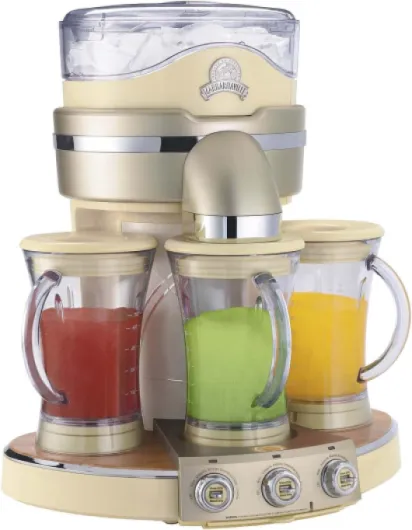
On paper, the Tahiti Concoction Maker is pretty straightforward: three 24 oz pitchers, one big ice hopper on top, and a motor that both shaves ice and blends. You can pick from six preset drink types: margarita, daiquiri, colada, mudslide, mojito, and smoothie. In practice, those presets just adjust how much ice it shaves and how long it blends, but they do help you get in the right ballpark without guessing every time.
The key feature is the rotating ice chute. You dump a big bag of ice (gas station style) into the top, and the machine automatically spins the chute over each pitcher, shaves the ice, drops it in, and then blends. You can run all three pitchers in one automatic cycle, or just use one or two if you’re making different things. Each station has its own controls, so you can do margaritas in the middle, smoothies on one side, and something else on the other without stopping to clean anything.
Realistically, each pitcher gives you about three to three and a half drinks once the ice is in, so one full cycle is roughly 9–10 drinks, depending on glass size. For a small gathering of 6–8 people, that’s enough to get everyone a drink quickly. For a 20–30 person party, you’re working the machine pretty constantly for the first round. The upside is you can pre-mix your liquid batches in containers and just dump them in, which speeds things up a lot and avoids measuring under pressure.
Where the machine really differs from a normal blender is consistency and the separation of shaving and blending. Instead of just crushing ice into random chunks, it shaves it and then blends it into the mix. That’s why the texture is closer to what you get at a resort bar. It’s not some miracle, but if you’ve used a $40 ice shaver or cheap blender before, the difference is obvious after the first run. You just need to understand that the presets are a starting point, not a guarantee of perfect drinks on the first try.
Pros
- Consistent frozen drink texture thanks to separate ice shaving and blending
- Three 24 oz pitchers with independent controls let you make multiple drink types at once
- Rotating ice chute and design create a fun, bar-like centerpiece for parties
Cons
- High price for something that’s mainly useful if you host parties often
- Recipe book is weak and requires a lot of tweaking to get good-tasting drinks
- Bulky, heavy, and a bit of a hassle to clean around the chute and blades
Conclusion
Editor's rating
The Margaritaville Tahiti Margarita Machine is basically a party appliance for people who actually throw parties. It’s big, a bit flashy, and not something you quietly tuck away, but when you load it up with ice and run three pitchers at once, it does exactly what you expect: consistent frozen drinks with a good texture and a bit of show. The rotating ice chute and lights are a bit over the top, but they do turn the machine into a focal point, and most guests seem to enjoy watching it work.
It’s not without flaws. The included recipes are pretty disappointing, so expect to spend a few rounds tweaking mixes before you find what your group likes. Cleaning the underside of the chute and working around the very sharp blades requires some care and a bit of patience. It’s also bulky and not cheap, so if you rarely drink frozen cocktails or have limited space, it’s hard to justify. For occasional use, a decent blender will be enough.
If you have a lake house, a deck bar, or you host bigger gatherings where frozen drinks are a regular thing, this machine starts to make more sense. It handles multiple drink types at once, keeps the ice water from diluting everything, and saves you from constantly rinsing a single blender jar. For that kind of user, I’d say it’s a solid, fun piece of gear. For everyone else, it’s a nice toy, but probably more than you really need.