
Summary
Editor's rating
Taste & texture: what the end result is like
Value for money: who should actually spend on this
Design: tall, heavy, but practical enough
Materials & build: feels solid, with a couple of plastic compromises
Durability & upkeep after repeated use
Performance: how well it actually freezes and churns
What you actually get with the Whynter ICM-201SB
Pros
- Built-in compressor means no pre-freezing bowls and easy back-to-back batches
- Consistent soft-serve texture in about 30–40 minutes with chilled ingredients
- Stainless steel bowl and body are easy to clean and feel solid
Cons
- Heavy and bulky, not ideal if you need to move or store it often
- Included recipes are minimal, so you need to find your own
- Bowl can stick in place if left too long in extended cooling mode

Specifications
View full product page →| Brand | Whynter |
An ice cream maker that doesn’t hijack your freezer
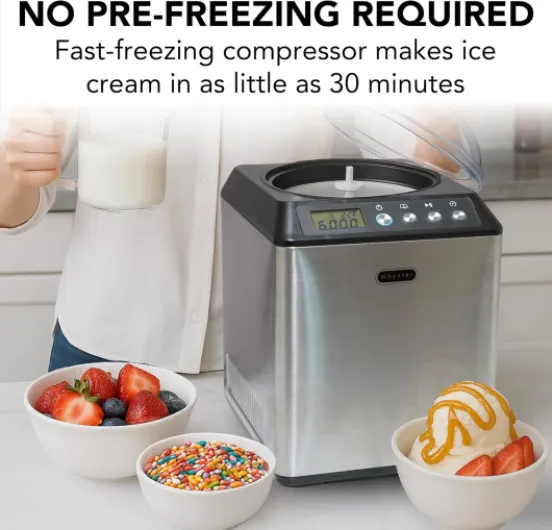
I’ve been using the Whynter ICM-201SB for a few weeks now, and the main thing that stands out is this: it finally lets you make ice cream on a random Tuesday night without having to plan 24 hours ahead. No bowl in the freezer, no rock salt, no ice. You plug it in, pour your mix, hit a couple buttons, and it starts chilling on its own. For me, that alone already puts it ahead of the “freeze-the-bowl” machines I used before.
Before this, I had one of those cheaper models where you keep a big metal bowl in the freezer permanently. In practice, that meant two things: it hogged freezer space, and if I forgot to re-freeze it after a batch, I was basically out of luck for at least a day. With the Whynter, the built-in compressor handles the cooling. It behaves more like a tiny freezer with a churner inside. I didn’t have to rearrange my freezer or remember anything in advance.
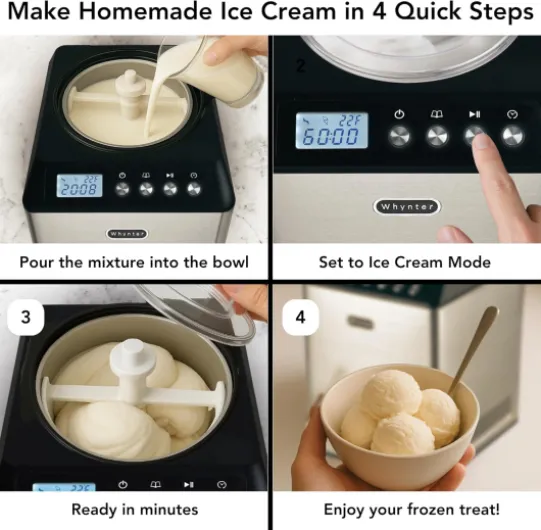
In day-to-day use, the process is pretty straightforward: mix your base (I mostly used simple cream/milk/sugar mixes), pour it into the stainless bowl, close the lid, set the timer (I usually go 40–50 minutes), and that’s it. The ice cream comes out at a soft-serve texture, then I move it to containers and let it firm up in the freezer. It’s not magic, but it’s predictable, and that’s what I care about. No half-frozen slush, no weird icy edges like I sometimes got with the old-style machines.
It’s not perfect. The unit is heavy, it takes up a decent chunk of counter space, and it’s not exactly cheap. But in terms of actually making ice cream regularly without turning it into a chore, it gets the job done very well. If you’re the kind of person who likes messing around with recipes and doing multiple batches for friends or family, this type of machine makes a lot more sense than the budget, freeze-the-bowl models.
Taste & texture: what the end result is like
Obviously the taste depends on your recipe, but this machine does affect texture and how well flavors come through. Compared to store-bought ice cream, what I got from the Whynter was noticeably more dense and richer, even with pretty basic recipes. Because there’s less air whipped in, the flavors feel stronger. A simple vanilla with real vanilla extract tasted more “there” than the cheap supermarket tubs. That’s not the machine being magical, it’s just not fluffing it up as much as commercial stuff.
Texture-wise, when it comes out of the machine it’s at that soft-serve stage: holds a peak but still soft enough to scoop easily. For me, that’s perfect for adding mix-ins. I usually dump the fresh batch into a bowl, stir in chocolate chips, nuts, or whatever, then pack it into containers. After a night in the freezer, it firms up. Without any alcohol in the mix, it can get pretty hard in a deep-freeze, but that’s normal. A small splash (like 1–2 tablespoons) of liqueur in the base or right after churning helps keep it a bit softer without turning it into slush.
One thing I noticed is that the machine does a good job avoiding big ice crystals, as long as your base is properly mixed and you don’t overload it. My fruit-based peach ice cream came out smooth, not icy, even though I used a decent amount of purée. The key is starting with cold ingredients. The one time I poured in a still-warm custard-style mix, it eventually worked, but it took longer and the texture wasn’t quite as tight as with a chilled base. So yes, the machine can handle warm mixes, but if you care about consistent texture, chilling the mix in the fridge first is still a good idea.
Overall, I’d say the machine lets you get very good homemade ice cream, gelato-style density if you want it, and sorbets that don’t feel like flavored ice. It won’t magically fix a bad recipe, but it gives you a stable, cold churn that helps you get the most out of decent ingredients. For everyday use, the taste and texture I got are more than good enough, and definitely better than what I was getting out of the cheaper freeze-the-bowl machine.
Value for money: who should actually spend on this
Price-wise, this sits well above the basic $50–$80 freeze-the-bowl machines, but below the very high-end Italian units. So the big question is: does the built-in compressor justify the cost? If you only make ice cream twice a year, honestly, probably not. A cheaper, pre-freeze bowl machine will do the job for occasional use. But if you like making ice cream regularly, or you want to do multiple flavors in one day, the convenience starts to feel worth it pretty quickly.
Think about it this way: with this Whynter, you’re paying for three main things: no pre-freezing, continuous use, and more consistent texture. In practice, that means you don’t waste freezer space on a big metal bowl, you can decide last-minute to make a batch, and you can do back-to-back flavors without planning ahead. For my household, that’s the difference between actually using the machine often versus letting it collect dust. Also, if you compare what good ice cream costs in stores (easily $4–$6 a pint), this thing starts to make financial sense after a bunch of batches, especially if you’re making 2-quart runs.
Compared to cheaper competitors, the Whynter feels more solid and has a good track record based on the number of positive user reviews. It’s not the fanciest looking, but it doesn’t feel flimsy, and the performance is consistent. On the downside, the lack of a decent included recipe booklet is a bit lazy for this price point, and the machine is heavy and bulky. If you’re tight on space or on a strict budget, that’s something to think about. Also, electricity use isn’t huge, but it’s still a compressor appliance, so it’s not as light on power as a simple motor-only churner.
Overall, I’d call the value good if you’re serious about making your own ice cream regularly and want the freedom to do it without planning. If you’re just curious and not sure you’ll stick with it, I’d say start with a cheaper option. This one makes more sense for someone who already knows they like homemade ice cream or wants to replace an older, annoying machine with something that’s more convenient and reliable.
Design: tall, heavy, but practical enough
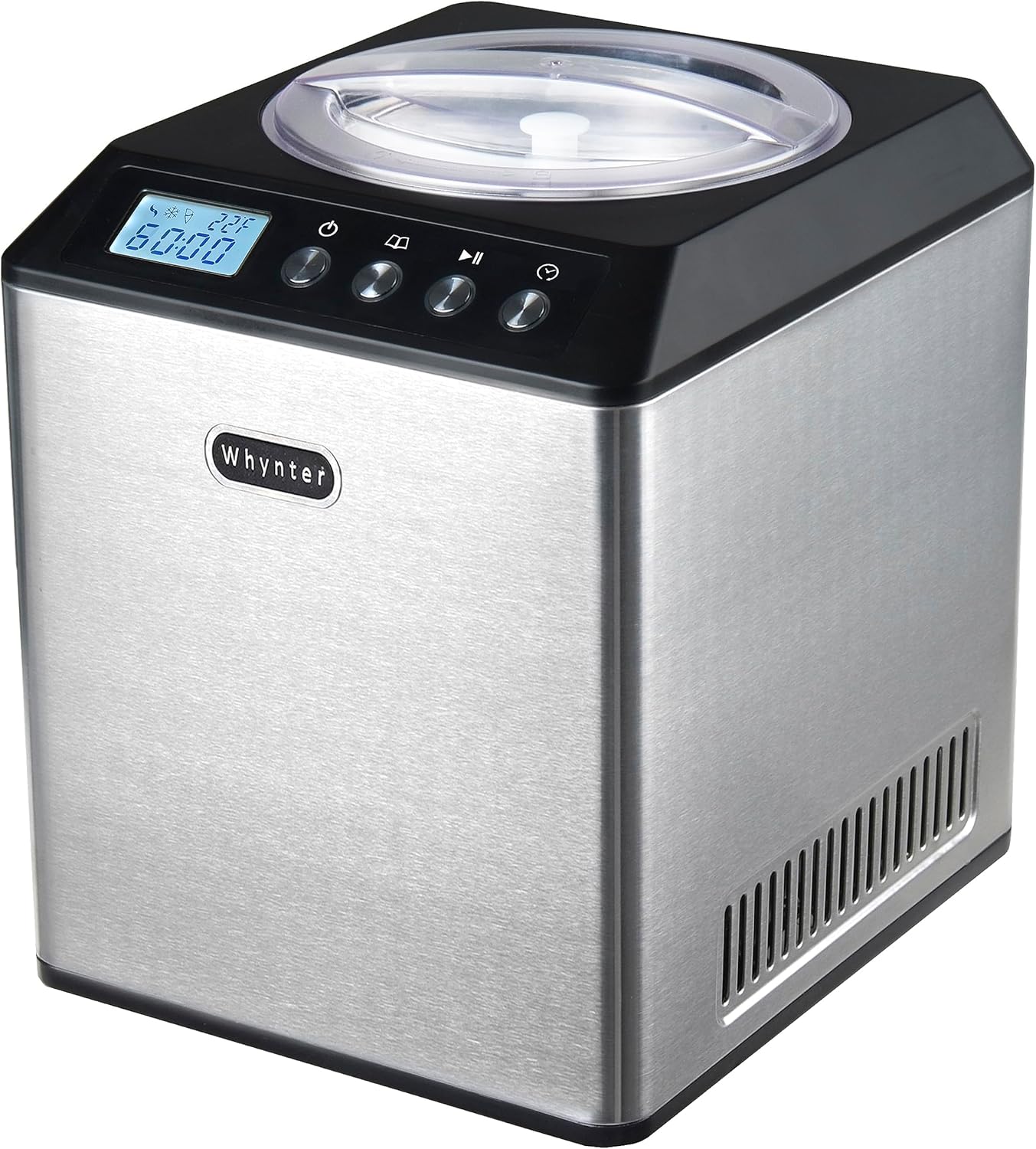
The design is pretty straightforward: stainless steel front and sides, black plastic top, and an upright, almost square footprint. It’s about 14.25" long, 12.5" wide, and 14.25" high. Compared to the wider, shorter ice cream makers I’ve used, this one is more like a tall box. On my counter, that actually works better because it doesn’t spread out too much, but you do need clearance above it to open the lid comfortably. If you’ve got low cabinets, measure first or be ready to pull it a bit forward when using it.
The clear lid on top is genuinely useful. You can watch the texture change as it churns and toss in mix-ins (chocolate chips, nuts, etc.) near the end without stopping the machine. The opening is wide enough to pour things in without making a mess, as long as you’re not trying to dump in a whole bowl at once. The soft-touch buttons and LCD are basic but easy to read. There’s no silly touch screen, just functional controls. I didn’t have to re-read the manual after the first use.
On the downside, the thing is heavy. At around 24 pounds, once it’s on the counter, it tends to stay there. I tried storing it in a lower cabinet for a few days and hauling it out when needed, and that got annoying fast. If you have limited counter space and like to move appliances in and out all the time, this isn’t ideal. Also, there’s no built-in cord wrap or anything fancy, so you just kind of tuck the cord behind it, which is fine but not super tidy.
Noise-wise, it’s quieter than my old rock-salt machine but not silent. It sounds like a small fridge plus a slow mixer. We could still watch TV in the next room with it running, but you do hear it. Venting is on the sides, so you can’t shove it tightly against the wall and block airflow. As long as you give it a few inches around, it runs fine. Overall, the design is practical and focused on function. Not pretty enough to show off as a decor piece, but clean and neutral enough that it doesn’t look out of place on the counter.
Materials & build: feels solid, with a couple of plastic compromises
Material-wise, the Whynter ICM-201SB is a mix of stainless steel, hard plastic, and a stainless steel removable bowl. The outer shell is mostly stainless, which is nice because it wipes down easily and doesn’t feel flimsy. The bowl itself is also stainless steel, and that’s a big plus. It feels sturdy, doesn’t stain, and handles both warm and cold mixtures without any issue. I’ve pulled it out right after a batch, rinsed it with warm water, dried it, and started another batch without drama.
The churn blade is plastic but BPA-free according to the specs. It doesn’t feel fragile, but you can tell it’s not metal. In use, it holds up fine; I haven’t seen any bending or weird noises from strain, even when the mix gets thick. The lid is clear plastic and clips into place. It doesn’t feel luxurious, but it seals well enough that you don’t get splatter everywhere. The gasket ring where the bowl sits inside the machine feels tight and does its job. When the machine goes into extended cooling, that gasket actually holds the bowl pretty firmly against the frozen chamber walls, which is both good (for cooling) and slightly annoying when you try to pull the bowl out if you waited too long.
The internal compressor part is obviously not visible, but from the weight and how it behaves, it’s clear this isn’t some flimsy toy. The machine doesn’t rattle or walk around on the counter. The feet grip the surface well. During cleaning, I noticed there aren’t a ton of weird crevices around the bowl opening, so you don’t end up with sticky residue in unreachable spots. A quick wipe with a damp cloth usually does it. You do have to be a bit gentle when prying the bowl loose if it’s really frozen in there—using the included spatula to break the seal at the top works, but I’d avoid jamming anything metal down there.
Overall, the materials feel like they’re built for regular home use, not professional kitchen abuse. It’s not bulletproof, but it doesn’t feel cheap either. The metal bowl and outer shell are the strong points. The plastic parts do their job, but I wouldn’t want to drop the lid or crank down too hard on the blade. For the price range, I’d call the build quality pretty solid, especially compared to the very lightweight units you get at big box stores.
Durability & upkeep after repeated use
I obviously haven’t owned this thing for years, but over several weeks with multiple batches each week, it’s held up well. No weird rattles, no sudden error messages, and no drop in performance. The compressor still chills quickly, and the motor sounds the same as day one. Given the weight and build, it doesn’t feel like something that’s going to fall apart in a year if you use it regularly, but of course that’s something only long-term owners can fully confirm. Looking at other user feedback, a lot of people mention using it for years, which is reassuring.
On the maintenance side, it’s all manual cleaning. The bowl and churn blade come out easily, and I’ve washed them both by hand and in the dishwasher. Hand washing is faster, but the dishwasher didn’t cause any damage so far. The inside chamber where the bowl sits just needs a quick wipe; you never pour anything directly in there, so it doesn’t really get dirty, just maybe a drip or two from spills. The exterior stainless cleans up with a damp cloth. No rust or discoloration so far.
One thing to be aware of: because the bowl sometimes sticks when it’s very cold, you need to be a bit gentle pulling it out. If you yank too hard on the handle when it’s frozen to the chamber, you could probably bend something over time. Using the little included spatula to break the seal at the top works and feels safer. Also, don’t run the machine in a cramped, hot corner; like any compressor appliance, it needs decent ventilation to avoid overheating. I kept a few inches around it and had no issues.
Given the price, I’d expect a few good years of use, and based on how it’s behaving so far, that seems realistic. It’s not some fragile plastic toy, but it’s also not an industrial machine. For home use—say a couple of batches a week during summer and occasional use the rest of the year—it feels up to the task. If you treat it roughly or move it constantly, I could see some wear on the plastic lid and handles, but the core parts (compressor, bowl, body) feel solid.
Performance: how well it actually freezes and churns
Performance is where this machine earns its keep. With cold ingredients from the fridge, most of my batches reached a good soft-serve texture in 30–40 minutes, even though the default timer is 60 minutes. I tested a few basic recipes: a simple vanilla (cream, milk, sugar, vanilla), a chocolate mix with cocoa and syrup, and a fruit-based mix with peach purée. In every case, the texture out of the machine was smooth and uniform, no big ice chunks or soupy spots. It’s not the fluffiest ice cream you’ll ever eat, but that’s normal for home machines—less air, more dense.
The built-in compressor is the key. You can run back-to-back batches without waiting for anything to re-freeze. I did two 2-quart batches in a row on a Saturday, and the only limiting factor was my patience, not the machine. The unit didn’t overheat or shut down unexpectedly. The motor protection did kick in once when I overfilled the bowl and the ice cream got very thick near the end; it simply stopped churning and went into cooling mode. That’s annoying in the moment, but better than burning out the motor. Once I learned to stay a bit under the max fill line, it stopped happening.
The extended cooling function is handy but has a small catch. If you walk away and let the machine switch into cooling-only mode for a while after the churning stops, the bowl can freeze pretty tightly to the chamber. It still comes out, but you sometimes have to wiggle it or gently slide the flat spatula between the bowl rim and the side to break the seal. Not a big deal once you know the trick, but the first time it feels like the bowl is glued in there. I’d say it’s better to check the machine around the 30–40 minute mark instead of just blindly leaving it at 60 minutes.
In terms of noise, it’s there but not crazy. You can hold a conversation in the kitchen while it’s running. The compressor hums and the churner makes a steady whirring sound. Compared to the old ice-and-salt style machine I had before, this is much more tolerable. As for freezing power, it gets the mix down to a firm soft-serve that holds its shape when scooped. If you want scoop-shop firmness, you still need to transfer it to containers and freeze for a few hours, but that’s standard. Overall, the performance is consistent, which is really what matters. It just quietly does the job batch after batch.
What you actually get with the Whynter ICM-201SB
Out of the box, the Whynter ICM-201SB is basically a compact metal cube with a removable stainless steel bowl, a plastic churn blade, a clear plastic lid, and a small spatula. That’s it. No fancy extras, no big recipe book, just the essentials. The capacity is listed as 2.1 quarts, but in real use I’ve found that filling it a bit below the maximum line (so closer to ~2 quarts) is safer to avoid overflow. The machine itself weighs around 24 pounds, so it feels more like a small appliance than a gadget. You’re not casually moving this around every day.
The controls are simple: an LCD display, a couple of buttons to set time and start/stop, and an option to pre-chill and to keep the mixture cold after churning. Nothing high-tech, but honestly that’s a good thing. I don’t need Wi‑Fi in an ice cream maker. The timer usually defaults to 60 minutes, but most of my mixes were done in 30–45 minutes if I started with cold ingredients from the fridge. There’s also a motor protection feature that stops the churning if the mixture gets too thick, so you don’t burn out the motor. I’ve seen it kick in a couple of times when I overfilled it or used a thicker base.
In practice, the main selling point is the built-in compressor. That’s what lets you do back-to-back batches without having to wait for anything to re-freeze. I made two different flavors in a row on a weekend: vanilla first, then a chocolate batch right after, just rinsing the bowl in between. The machine didn’t struggle or overheat. It’s roughly the size of a bread maker, so if you leave it out on the counter it’s convenient. If you plan to store it in a cabinet and lift it up each time, be aware it’s on the heavy side.
So overall, the presentation is pretty straightforward: no gimmicks, just a solid compressor unit, a clear lid so you can see what’s going on, and a bowl that’s easy to pull out. It feels geared toward someone who genuinely plans to use it often, not just once a year. If you were expecting a bunch of fancy recipe cards or accessories, you’ll be a bit underwhelmed, but the core machine is what matters and that part feels well thought out.
Pros
- Built-in compressor means no pre-freezing bowls and easy back-to-back batches
- Consistent soft-serve texture in about 30–40 minutes with chilled ingredients
- Stainless steel bowl and body are easy to clean and feel solid
Cons
- Heavy and bulky, not ideal if you need to move or store it often
- Included recipes are minimal, so you need to find your own
- Bowl can stick in place if left too long in extended cooling mode
Conclusion
Editor's rating
The Whynter ICM-201SB is a solid, no-nonsense ice cream maker for people who actually plan to use it often. The built-in compressor is the key feature: no more pre-freezing bowls, no more rock salt, and no more planning a day ahead just to make a batch. In real use, it turns out consistent, smooth ice cream, gelato-style mixes, and sorbets in around 30–40 minutes with chilled ingredients. The machine feels sturdy, the stainless bowl is easy to clean, and being able to do back-to-back batches without waiting is genuinely practical.
It’s not perfect. It’s heavy, takes up a good chunk of counter space, and the included recipe material is pretty bare-bones, so you’ll probably end up hunting for recipes online or buying a cookbook. The bowl can stick a bit if you let it sit in extended cooling mode too long, and it’s not the cheapest option out there. But if you compare it to the hassle of cheaper ice cream makers and the price of good store-bought ice cream, it starts to look like decent value for regular use.
I’d recommend this to anyone who: likes making ice cream more than a couple of times a year, wants the flexibility to do multiple flavors in one day, and doesn’t mind leaving a fairly big appliance on the counter. If you’re just ice-cream-curious, short on space, or on a tight budget, you might be better off with a basic pre-freeze bowl machine. For home cooks who actually enjoy making frozen desserts and want something reliable that just gets the job done, this Whynter model is a pretty solid choice.