
Summary
Editor's rating
Value for money: tempting price, but you’re rolling the dice
Simple under-counter design that looks fine but feels basic
Stainless steel shell, basic guts – fine if you treat it gently
Durability and reliability: the weak spot
When it runs, it makes plenty of ice – the real issue is consistency
Specs that look strong for the price
Does it actually solve the “no ice” problem day to day?
Pros
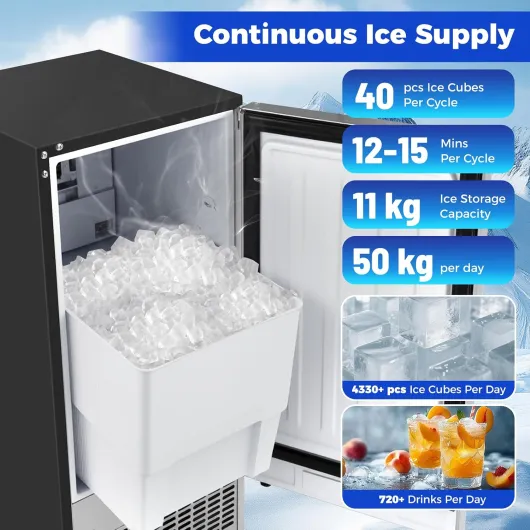
- High ice production capacity (up to 50 kg/24h) and 15 kg storage for a relatively low price
- Under-counter format with stainless steel shell that looks decent in a bar or kitchen
- Auto water supply, digital controls, adjustable ice thickness, and self-cleaning mode
Cons
- Mixed reliability with reports of early failures and recurring breakdowns
- Sensitive to water quality; needs frequent cleaning and probably a filter for stable performance
- After-sales support and troubleshooting seem limited compared to bigger commercial brands

Specifications
View full product page →| Brand | COSTWAY |
A budget commercial ice maker that looks tempting, but…
I picked up this COSTWAY commercial ice maker because I was tired of constantly running out of ice during busy evenings. On paper, the specs look pretty good: 50 kg of ice per day, 15 kg storage, stainless steel body, under-counter format. For the price, it seemed like a decent way to get a semi‑pro setup at home or for a small bar without paying for a big brand like Hoshizaki or Scotsman.
After using it, my feeling is more mixed. It can produce a good amount of ice, and when it runs properly, it does the job. But it’s clearly not a plug‑and‑forget machine. You have to be ready to clean it often, keep an eye on it, and accept that reliability is not its strongest point. The Amazon rating around 3.2/5 matches my experience pretty well: not a total disaster, but far from bulletproof.
What pushed me to try it was the under‑cabinet design and the automatic water connection. I wanted something that just keeps producing ice without me refilling a tank every two hours. Technically, this one does that, but you have to be ready to tinker a bit: water line, drain hose, and regular descaling or cleaning if your water is hard or has a lot of chloride.
If you’re thinking about this machine for a bar, a food truck, or even a big family that burns through ice, I’ll walk you through what works, what’s annoying, and where it clearly shows its low‑cost side. It’s not terrible, but you need to know what you’re getting into before buying it.
Value for money: tempting price, but you’re rolling the dice
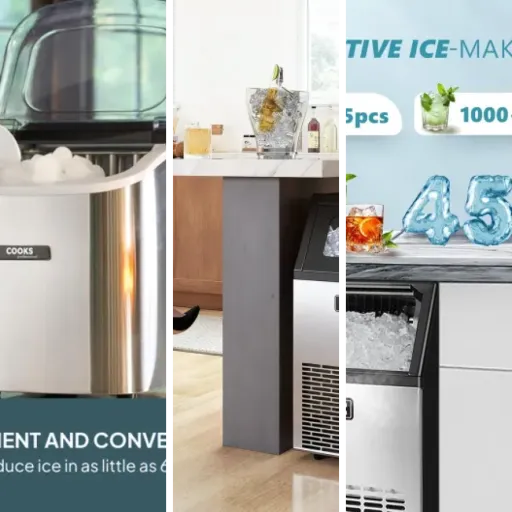
From a value perspective, this COSTWAY ice maker sits in that awkward middle ground. It’s clearly cheaper than big commercial brands, and for the specs (50 kg/24h, 15 kg storage, stainless steel shell, auto water supply), the price is attractive. If you compare it to high‑end machines with similar output, you’re paying a lot less. That’s what makes it tempting for small businesses or home users who want “commercial style” ice without a huge investment.
But you have to factor in the hidden costs and risks. First, you almost certainly need a water filter or softener if your water is hard or has a lot of chlorine or minerals. That’s extra money and extra maintenance. Second, if something breaks after the return window, you might be stuck with a machine that’s not worth repairing. Several users already had issues within days, which is not reassuring. Even if your unit works fine, the constant cleaning and the risk of breakdowns is a cost in time and stress, especially if you rely on it for business.
For a home user who wants a big ice supply for summer, parties, or a home bar, the value is reasonable if you go in with realistic expectations. It’s cheaper than a full‑on pro machine, and if you maintain it, it can keep you stocked with ice. If it dies after a couple of years, you might still feel you got your money’s worth, depending on how often you used it. For a business, though, the equation is different. Downtime, lost service, and the hassle of replacing a machine can easily outweigh the saving you made at the start.
So overall, I’d say the value is “decent but not outstanding.” You’re paying less upfront, but you’re also accepting lower reliability and weaker support. If you’re okay with that trade‑off and you’re handy enough to clean and troubleshoot regularly, it can be a good budget option. If you want something you can install and forget, this is probably not the right choice, even if the price looks nice at first glance.
Simple under-counter design that looks fine but feels basic
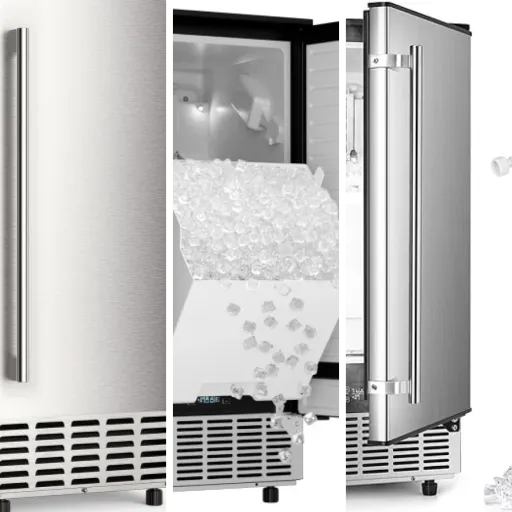
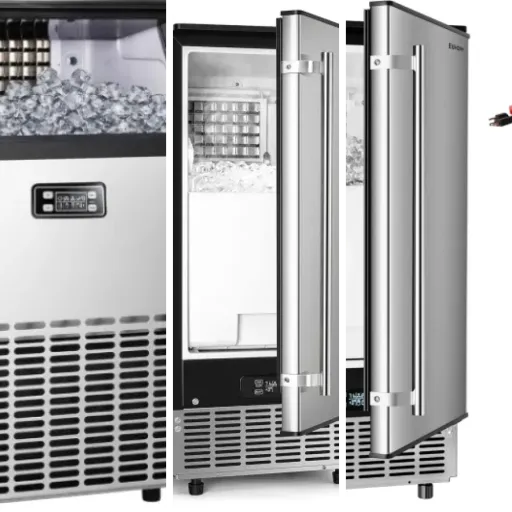
Design‑wise, this ice maker is pretty straightforward. It’s basically a rectangular stainless steel box with a black top and a front door that flips open so you can scoop out the ice. The look is neutral and practical. It doesn’t scream high‑end, but it doesn’t look cheap and plastic either from a distance. In a bar or under a kitchen counter, it blends in well enough and doesn’t attract attention, which is fine for a machine like this.
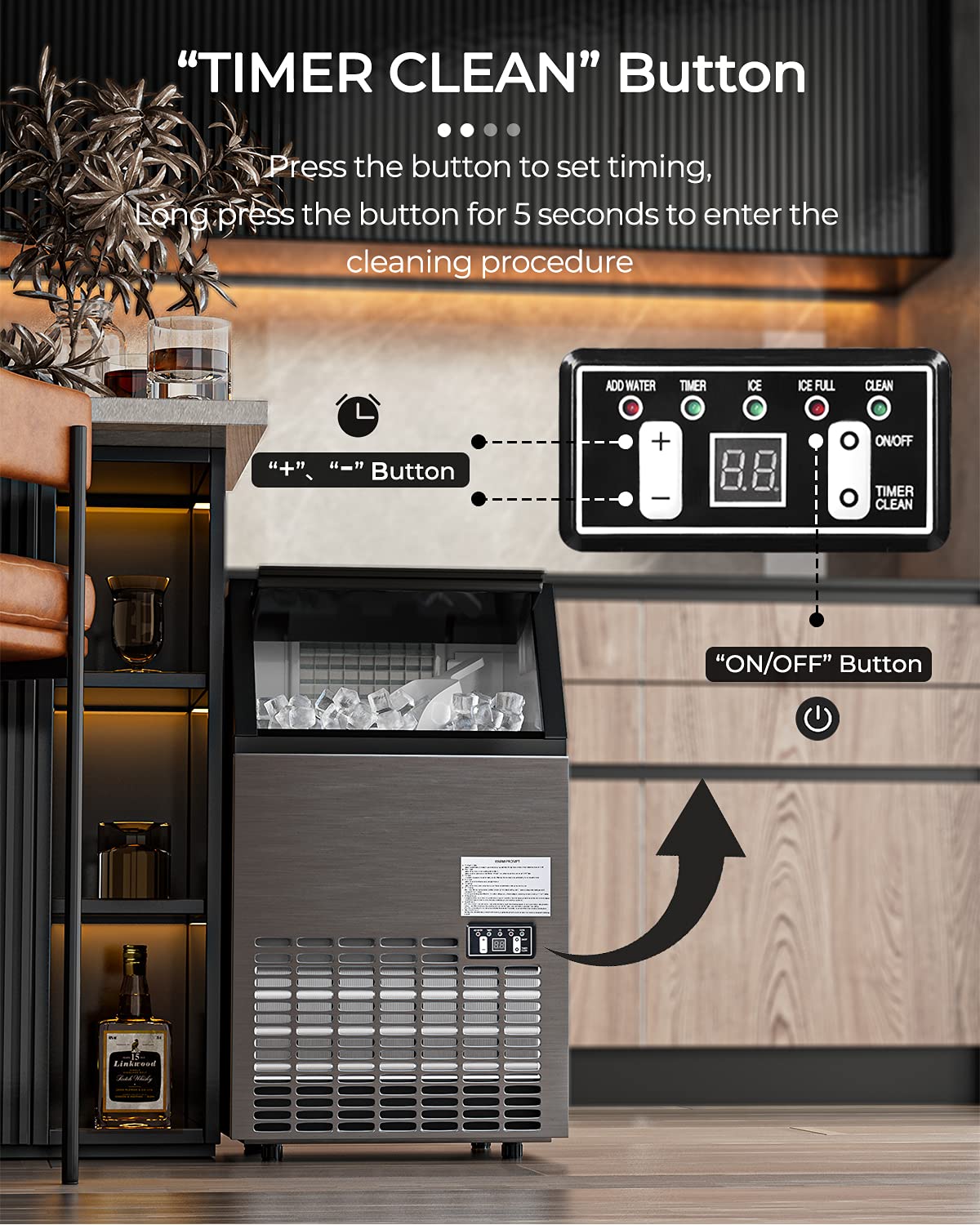
The under‑counter format is handy. At about 80 cm high, it fits under most standard counters, and the front access makes it easy to grab ice quickly. The front digital panel is small but readable, and you can see the basic status: room temperature, ice making, full bin, or water shortage. The door window lets you peek inside without opening it fully, which is useful to see how much ice you’ve got left. The openable front panel is light and easy to handle, not heavy like some bigger commercial machines.
That said, once you touch it, you feel where they saved money. The metal sheets are thin, the plastic parts inside don’t feel very robust, and the overall build doesn’t inspire long‑term confidence. It’s okay for a light commercial or home setup, but I wouldn’t put this in a busy nightclub and expect it to survive years of abuse. Some users have also had issues right out of the box (like faulty water floats), which kind of confirms that quality control is not top tier here.
In use, the design is practical but not perfect. Access to the back connections (water inlet and drain) is a bit annoying once the unit is installed under a counter. If you don’t plan the installation well, you’ll be crawling on the floor to check hoses. Also, because it’s freestanding, you need to leave some space around it for ventilation. If you box it in too tightly, the heat builds up, the compressor works harder, and the life of the machine will probably shrink. So, design: functional, looks okay, but clearly built to hit a price point, not to last forever.
Stainless steel shell, basic guts – fine if you treat it gently
The machine is advertised as stainless steel, and yes, the outer shell is stainless steel. It gives it a more professional look and helps with cleaning the outside; you can wipe off splashes and fingerprints without trouble. Under that, there’s a foaming insulation layer and an inner plastic liner. The three‑layer structure (inner liner, foam, steel) is supposed to help with heat insulation so the ice doesn’t melt too fast once it’s in the bin. In practice, the storage is not refrigerated like a freezer; it’s more like a cooled box. The insulation is decent, but if the room is hot, the ice will still slowly melt if the machine stops running.
Inside the bin, the plastic feels average. It’s not flimsy to the point of breaking in your hands, but it doesn’t feel like heavy‑duty commercial gear either. The included scoop is a basic plastic scoop – it works, nothing more. The hoses are also standard budget hoses. I’d personally upgrade the water line to a better quality food‑grade tube and a proper valve if you plan to use this daily. Same for the drain: make sure it’s well secured and has a good slope, because if the drain clogs or backs up, you’ll have standing water in and around the machine.
The condenser and compressor are where the long‑term durability really plays out, and that’s harder to judge by eye. Some users got units that worked fine, others had early failures (pump, float, or general error codes). That usually points to inconsistent internal components or weak quality control. I didn’t open the machine fully to inspect every part, but from the noise level and the way it runs, it’s clearly not using top‑of‑the‑line components. It’s more in the “budget commercial” category than “heavy‑duty restaurant” category.
To sum it up, the materials are okay for light to medium use, especially if you’re careful and keep it clean. But if you expect thick stainless panels, rock‑solid hinges, and industrial‑grade internals, this is not it. It’s a compromise: stainless look on the outside, fairly basic parts inside. If you take care of it, it should last a while, but I wouldn’t count on it for super intensive, non‑stop service without issues popping up over time.
Durability and reliability: the weak spot
This is where things get a bit rough. Durability and reliability are honestly the main concern with this COSTWAY ice maker. There are several verified reviews mentioning early failures: one unit faulty straight out of the box with water that wouldn’t stop running, another that broke after the second day with an error code and no water pumping in, and another user saying it keeps breaking down and they can’t reach anyone for help. That’s not what you want to see for a machine that’s supposed to run daily.
My own impression matches this general feeling: it doesn’t feel like a machine built to take years of abuse. The thin metal, basic plastic internals, and the fact that it’s very sensitive to water quality all point to a product that will need more care and might not handle heavy commercial use for long. If you treat it gently, keep it clean, and don’t run it 24/7 in a hot, cramped space, it will probably last longer. But if you push it hard every day, I wouldn’t be shocked if pumps, floats, or sensors start acting up sooner than you’d like.
The lack of strong after‑sales support mentioned in the reviews is another red flag. If something goes wrong, getting spare parts or clear guidance doesn’t seem easy. That’s a big difference compared to established commercial brands where you can call a service company and get parts quickly. Here, you’re more or less at the mercy of the seller and Amazon’s return window. Once that’s over, repairs might be more trouble than they’re worth, especially given the price of the unit compared to pro gear.
So, in terms of durability, I’d rate it as “okay for occasional or light commercial use, but not something I’d trust as my only ice source in a busy business.” For a home bar or a small operation where you can live with downtime or have a backup (bags of ice from the store), it’s acceptable. For a serious bar that needs ice every night, I’d invest in something more robust, even if it costs more upfront.
When it runs, it makes plenty of ice – the real issue is consistency
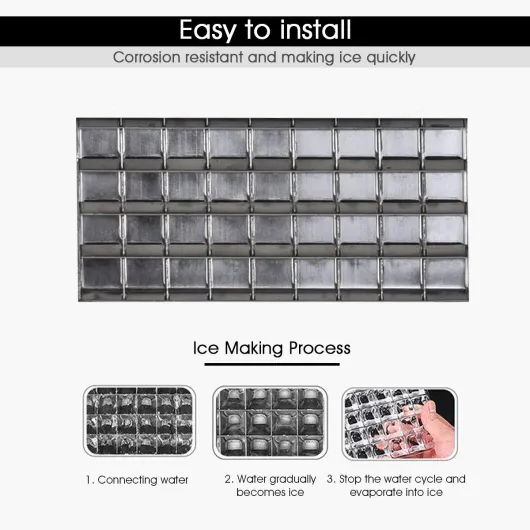
Let’s talk performance, because that’s the main reason to buy this machine. When it’s working properly, the COSTWAY does produce a good amount of ice. The 12–18 minute cycle time for about 45 cubes is realistic, especially if your room isn’t too hot and your water is reasonably cold. Over a full day, you can get close to the advertised 50 kg, but only if you’re emptying the bin regularly and letting it run non‑stop. For home use or a small bar, that’s more than enough capacity.
The cubes themselves are the usual hollow or partially hollow commercial style. You can adjust the thickness via the control panel by changing the cycle length. If you extend the cycle, you get thicker cubes that last longer in drinks but take more time to produce. If you shorten it, you get faster production but softer cubes that melt faster. The machine doesn’t give you super pretty gourmet cubes, but for cocktails, sodas, and basic service, they’re fine. It’s not fancy, it just makes ice that cools drinks, which is the point.
Now, the big downside is reliability and maintenance. Several users (and my own experience) reported issues like the water line getting blocked by chloride, pumps not running, water not stopping, or random error codes. One reviewer said it blocked every 4–5 days due to chloride and needed frequent cleaning. Another had it fail on day two. That’s the real problem: you can’t fully trust it for mission‑critical use without a backup plan. If you have hard or chlorinated water, you almost definitely need a filter and a regular cleaning schedule, otherwise the performance drops fast.
Noise level is acceptable for a machine of this type. The condenser is reasonably quiet; it’s not silent, but it’s not going to drown out conversation in a bar. You’ll hear it hum and dump ice into the bin, but it’s manageable. Overall, performance is decent as long as you stay on top of cleaning and your unit doesn’t draw the short straw in terms of defects. That’s the gamble with this machine: solid capacity for the price, but with a higher risk of hiccups compared to bigger brands.
Specs that look strong for the price
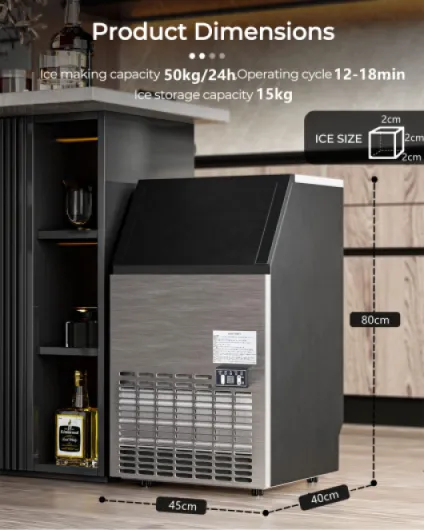
On paper, the COSTWAY commercial ice maker has a pretty solid spec sheet for a budget machine. It claims up to 50 kg of ice every 24 hours, with each batch giving roughly 45 cubes in about 12–18 minutes. The storage bin holds about 15 kg of ice, which is more than enough for a home bar and should cover a small cafe or takeaway if you manage it properly. It runs on 240V with around 200W of power usage, and uses R600a refrigerant, which is standard these days.
The unit itself is about 45 cm deep, 40 cm wide, and 80 cm high. That means it can slide under most counters, but you still need a bit of ventilation space around it and access to the front door to grab the ice. It’s a freestanding machine, not built‑in, so don’t shove it in a completely closed cabinet or it’ll overheat faster and probably die earlier. It also needs a water inlet and a drain line: this is not a countertop tank‑fill machine.
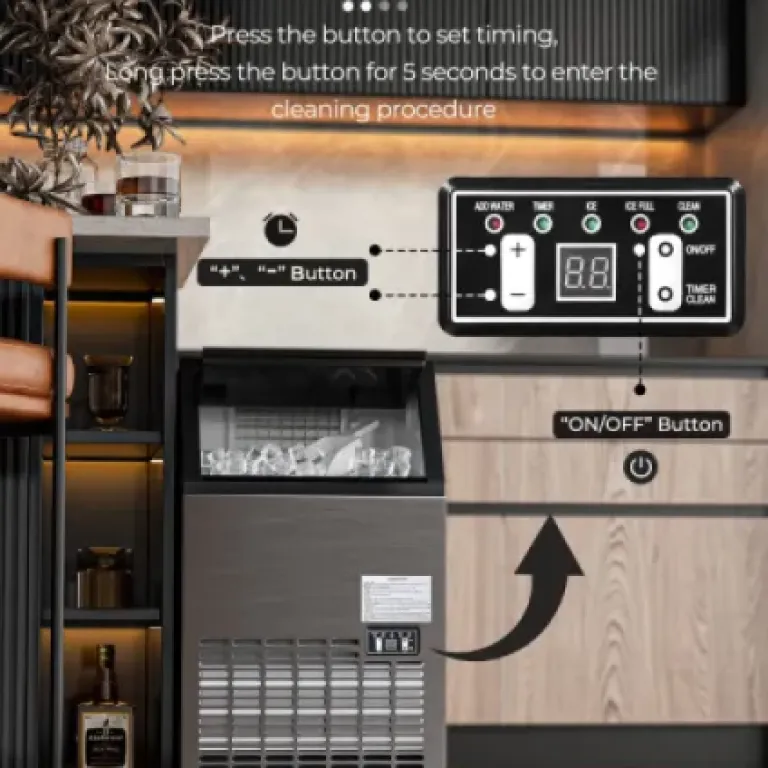
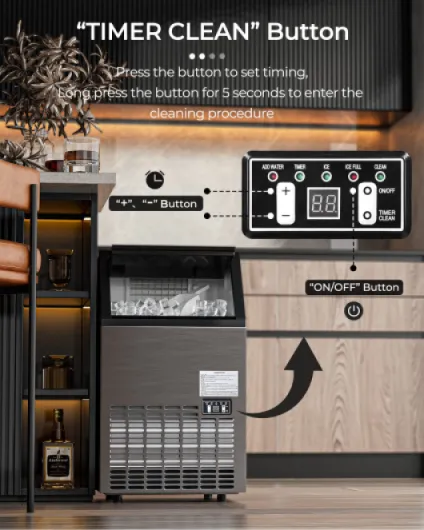
In terms of features, it comes with a digital display with basic controls, a timer for delayed start/stop, and a self‑cleaning mode if you press the timer button for more than five seconds. You can also adjust ice thickness by changing the cycle time, which is handy if you want harder cubes that melt more slowly or faster production with thinner cubes. It includes a plastic ice scoop, inlet and outlet hoses, and a quick connector for the water line. Nothing fancy, but it’s enough to get you started.
Overall, the feature list is decent: auto water supply, auto clean, digital control, under‑counter format, stainless steel finish. If you just read the description, you’d think you’re getting a small professional machine at a bargain. In reality, the functions are there, but the execution is a bit rough. The basics are covered, but you can tell it’s a budget product, especially when you look at long‑term reliability and how often it needs attention to keep it running smoothly.
Does it actually solve the “no ice” problem day to day?
In practice, the real question is: does this machine actually fix your constant “we’re out of ice” issue? For light to medium use, I’d say yes, but with some babysitting. If you run a small bar, a cafe, or host a lot of parties at home, the sheer volume it can produce is enough to keep up. As long as the machine is clean and the water flow is good, it keeps churning out batches. You can fill coolers, prep for service, and not worry about freezing trays in advance.
Where it falls short is in how often you have to intervene. The self‑cleaning mode is a nice idea, but it doesn’t replace proper manual cleaning and descaling if your water is hard or has a lot of minerals. One user mentioned the water line getting blocked with chloride every 4–5 days, which matches what happens with cheap commercial machines on bad water. You basically have to treat this like a coffee machine in a hard‑water area: regular descaling, maybe even a filter or softener upstream. If you skip that, the effectiveness drops, you get error codes, or it just stops making ice.
The digital indicators for “ice full” and “water shortage” are helpful. They prevent the machine from running dry or overfilling the bin. The timer function for delayed start/stop is a small bonus if you want it to start making ice before opening hours or shut off automatically at night. These features work fine and make day‑to‑day use a bit easier. But again, they don’t solve the core issue of reliability; they just make operation smoother when the hardware is behaving.
So in terms of effectiveness: it does the job if you’re willing to maintain it and accept that it’s not bulletproof. For a home user who wants a lot of ice in summer and can live with the occasional hiccup, it’s workable. For a business that needs ice every single day without fail, I’d be cautious. You might end up spending more time troubleshooting than you’d like, and when it breaks, support doesn’t seem super responsive based on some reviews.
Pros
- High ice production capacity (up to 50 kg/24h) and 15 kg storage for a relatively low price
- Under-counter format with stainless steel shell that looks decent in a bar or kitchen
- Auto water supply, digital controls, adjustable ice thickness, and self-cleaning mode
Cons
- Mixed reliability with reports of early failures and recurring breakdowns
- Sensitive to water quality; needs frequent cleaning and probably a filter for stable performance
- After-sales support and troubleshooting seem limited compared to bigger commercial brands
Conclusion
Editor's rating
The COSTWAY Commercial Ice Maker 50kg/24h is one of those machines that looks great on paper: plenty of capacity, under‑counter design, stainless steel shell, auto water supply, and self‑cleaning. When it’s running properly, it produces more than enough ice for a home bar or a small business, and the cubes are perfectly fine for everyday drinks. For the price, the raw performance is not bad at all.
But there are clear trade‑offs. Build quality feels budget, the machine is quite sensitive to water quality, and several users have had early failures or recurring breakdowns. Support doesn’t seem very responsive, and you need to be ready to clean and possibly tinker with it regularly. This is not a “install and forget” unit; it’s more of a “cheap commercial‑style machine that needs attention.”
If you’re a home user or running a very small operation and you want a lot of ice without paying for a big brand, this can make sense, as long as you accept the maintenance and the risk. If you’re opening a bar or cafe and ice is critical to your business, I’d skip this and save up for something more reliable. In short: it gets the job done when it works, but you’re rolling the dice a bit on long‑term reliability.